You're PCSing to Hill AFB and want to buy instead of rent. Here's exactly how to use a VA loan to buy a home in Utah as an active duty service member — eligibility, timing, offers, and closing.
Key Takeaways
- 90 continuous days of active duty meets the VA minimum service requirement — no years-in-service needed.
- With full entitlement, the VA sets no loan limit — your lender's underwriting is the real ceiling.
- First-use funding fee is 2.15% with under 5% down, and it can be financed into the loan.
- Every VA loan is assumable, but the buyer must cover the equity gap in cash.
- Start preapproval the day orders drop, not the day you land in Utah.
See What's For Sale Right Now
Browse every active Northern Utah listing on a live map — updated straight from the MLS.
In this article
- How do I use a VA loan to buy a home in Utah as an active duty service member?
- Do I qualify yet? VA eligibility for active duty
- Zero down and no loan limit: what full entitlement really means
- What if I already used my VA loan? Partial entitlement explained
- The VA funding fee: what it costs and how to avoid paying cash
- Timing your Utah home purchase around PCS orders
- Occupancy rules, deployments, and buying with a power of attorney
- The VA appraisal and Minimum Property Requirements in Utah
- VA assumable loans in Utah: the overlooked option
- Where VA buyers actually shop near Hill AFB
- How to make a VA offer sellers actually accept
- Is a VA loan actually right for you? An honest answer
How do I use a VA loan to buy a home in Utah as an active duty service member?
Confirm eligibility, get your Certificate of Eligibility, get fully underwritten by a VA-experienced lender, then make an offer. With full entitlement you need no down payment and, per the VA, no loan limit.
The path is the same everywhere, but the pace is different when you're on orders. You're working against a report date, not a wish list.
Here's the sequence that actually works for service members heading to Hill Air Force Base:
- Confirm you meet the VA service requirement.
- Request your Certificate of Eligibility (COE).
- Get preapproved — ideally fully underwritten — with a lender who closes VA loans in Utah regularly.
- Pick your target towns before you tour, not after.
- Write an offer with a VA-aware agent.
- Clear the VA appraisal and the Minimum Property Requirements.
- Close and certify occupancy.
Every one of those steps has a Utah-specific wrinkle. We'll walk them in order, including the parts nobody warns you about — seismic water heater straps, peeling paint on pre-1978 homes, and what happens to your entitlement if you already own a house back at your last duty station.
Do I qualify yet? VA eligibility for active duty
According to the VA, current active-duty service members meet the minimum service requirement after at least 90 continuous days of service, all at once, without a break in service. Guard and Reserve qualify differently.
This surprises a lot of first-term Airmen. You don't need years in — you need 90 continuous days.
Per the U.S. Department of Veterans Affairs, active-duty members meet the minimum service requirement after at least 90 continuous days of service — served all at once, without a break in service. National Guard and Reserve members qualify through 90 days of non-training active-duty service, or through six creditable years of service.
Meeting the service requirement is not the same as loan approval. It gets you the VA guaranty. Your lender still has to approve you on credit, income, debts, and assets.
Get your COE early. Your lender can usually pull it electronically in minutes, and you want that box checked before you're staring at a listing you love with three other offers on it.
One note for Guard and Reserve members stationed or living in Utah: the six-creditable-years path and the 90-day active-duty path are separate doors to the same room. You only need one of them.
Zero down and no loan limit: what full entitlement really means
With full VA entitlement, the VA states you do not have a loan limit as long as you can afford the loan and the appraisal supports the price. Your lender's underwriting is the real ceiling.
This is the single most misunderstood part of the VA program.
The VA is explicit: a borrower with full entitlement has no VA loan limit. You can borrow what you can afford and what the property appraises for. The lender must still approve you on credit, income, debts, and assets.
So the real limit is your debt-to-income ratio, not a government cap. Your BAH counts as qualifying income for most VA lenders, which is a meaningful advantage over civilian buyers shopping the same price band in Davis County.
Zero down is also real, and there's no monthly mortgage insurance on a VA loan. That combination is what lets a Staff Sergeant compete for the same house as a dual-income couple with 10% saved.
A caution worth saying out loud: no loan limit is not the same as unlimited buying power. Approved and affordable are different numbers, and the VA's residual income test is there for a reason.
What if I already used my VA loan? Partial entitlement explained
With partial entitlement, the VA uses your county's one-unit conforming loan limit multiplied by .25, minus entitlement already used. Most lenders want entitlement plus down payment to cover 25% of the loan.
Plenty of people arrive at Hill AFB still owning a VA-financed house from a prior duty station. You are not locked out.
Per the VA, when you have partial or remaining entitlement the calculation uses the county one-unit conforming loan limit multiplied by .25, minus the entitlement you've already used. Most lenders require entitlement, a down payment, or a combination of the two to cover at least 25% of the total loan amount. Basic entitlement is $36,000.
The VA also confirms that VA home loan limits are the same as Federal Housing Finance Agency (FHFA) conforming loan limits. So the figure that matters for a Weber or Davis County purchase is the current-year FHFA one-unit limit for that county, which the FHFA publishes annually.
Practical translation: with remaining entitlement you may need some cash down, but often far less than a conventional loan would require.
Restoring entitlement is a separate process. If you sold the prior home and paid off that VA loan, ask your lender to start the restoration paperwork the week you get orders — not two weeks before closing in Utah.
The VA funding fee: what it costs and how to avoid paying cash
Per VA rates effective April 7, 2023, first use is 2.15% with less than 5% down, 1.5% with 5% or more down, and 1.25% with 10% or more down. The fee can be financed into the loan.
The VA charges a one-time funding fee on most purchase loans. It's what keeps the program running without a taxpayer subsidy.
Here are the current purchase rates published by the U.S. Department of Veterans Affairs, effective April 7, 2023:
| Down payment | First use | Subsequent use |
|---|---|---|
| Less than 5% | 2.15% | 3.3% |
| 5% or more | 1.5% | 1.5% |
| 10% or more | 1.25% | 1.25% |
Notice the jump on subsequent use with nothing down: 3.3%. If this is your second VA loan and you have some savings, putting 5% down drops the fee to 1.5% — the same rate a first-time user pays at that tier. That's a real decision worth running the math on with your lender.
The VA confirms the fee can be financed into the loan, so it doesn't have to come out of pocket. Some borrowers are exempt from the fee entirely; the VA lists those exemption categories on the same page.
Timing your Utah home purchase around PCS orders
Start lender preapproval the day orders drop. Most buyers should aim to be under contract roughly 45 to 60 days before their report date, working the calendar backward from closing.
The most expensive mistake I see is waiting until you land in Utah to start. By then you're in a hotel or TLF with a clock running and a moving truck in limbo.
Start the lender before you start the house hunt. Preapproval is paperwork you can complete from your current duty station, and a fully underwritten preapproval makes your offer far stronger than a one-page letter.
A workable rhythm:
- Orders in hand: request your COE, interview three lenders, submit documents.
- House hunting trip or virtual tours: narrow to two or three towns first.
- Under contract: VA appraisal ordered immediately, inspection scheduled inside the first week.
- Closing: ideally near, not far ahead of, your arrival window.
Our PCS relocation guide for Hill AFB lays out the full timeline, and the free 208-page relocation guide covers what to handle at each stage — including what to do if your orders change mid-transaction.
Occupancy rules, deployments, and buying with a power of attorney
VA loans require you to certify you intend to occupy the home as your primary residence within a reasonable time. Deployed members commonly close using a specific power of attorney or spousal occupancy.
The VA loan is for a home you live in. It is not an investment-property loan on day one, and lenders take that seriously.
You certify intent to occupy as your primary residence within a reasonable period after closing. For a service member on orders, lenders routinely accept a report date as the basis for that timeline.
If you're deployed or TDY, plan the power of attorney early. Title companies and lenders are picky about POA language, and a generic one often gets rejected at the closing table. Get a specific POA that names the property transaction, then send it to your lender and title company for review weeks in advance.
A spouse occupying the home can also satisfy the occupancy requirement in many cases. Confirm the details with your specific lender rather than assuming — policies differ between investors.
Later, once you've occupied the home and new orders send you elsewhere, renting it out is normally fine. Your entitlement stays attached to that loan until it's paid off or assumed, which matters for your next purchase.
Free PCS to Utah Relocation Guide
Get my Hill AFB relocation packet — neighborhoods, VA loan tips, schools, and timelines — sent to your inbox.
The VA appraisal and Minimum Property Requirements in Utah
A VA appraisal sets value and checks Minimum Property Requirements — safe, structurally sound, sanitary. Older Ogden and Layton homes most often trip on peeling paint, roof condition, and water heater strapping.
The VA appraisal does two jobs at once. It confirms the value and it confirms the house is livable.
Northern Utah has a lot of great housing stock built before 1978, especially in central Ogden and older pockets of Layton and Clearfield. Charming homes — and homes where a VA appraiser will absolutely note chipping paint.
Items that commonly come up on VA appraisals here:
- Peeling or chipping paint on pre-1978 homes
- Roof condition and remaining useful life
- Water heater seismic strapping, which matters along the Wasatch Front
- Exposed wiring, missing handrails, broken windows
- Crawl space moisture and lot drainage
None of these kill a deal by themselves. They become repair negotiations. The trick is spotting them before you write the offer, which is exactly what a VA-experienced agent is doing while walking the property with you.
If the appraised value comes in below the contract price, ask your lender about the Tidewater process — it gives your agent a short window to submit comparable sales before the appraisal is finalized. And remember: a VA appraisal is not a home inspection. Get both.
VA assumable loans in Utah: the overlooked option
Every VA loan is assumable with lender and VA approval, letting a buyer take over the seller's existing rate. The catches are covering the equity gap in cash and a slower approval timeline.
This is the part most buyers have never heard of, and it's worth understanding before you rule it out.
VA loans are assumable. A qualified buyer can take over the existing loan — including its interest rate — with lender and VA approval. When an older loan carries a below-market rate, that's a serious monthly payment advantage.
Two things make a VA assumable loan in Utah harder than it sounds:
- The cash gap. You must cover the difference between the purchase price and the remaining loan balance, usually in cash or through a second loan.
- The timeline. Assumption approval runs through the loan servicer and typically takes longer than a standard closing — which is a real problem when you have a report date.
There's also an entitlement consequence for the seller. If the buyer is not a veteran or service member substituting their own entitlement, the seller's entitlement stays tied to that loan, potentially for years. If you're the one selling, that can block your next VA purchase.
Assumable opportunities don't advertise themselves clearly on the MLS. If you want them flagged during your search, say so up front and we'll watch for them.
Where VA buyers actually shop near Hill AFB
Most Hill AFB buyers concentrate in Layton, Clearfield, Syracuse, Clinton, Roy, South Weber, and Ogden. The choice usually comes down to which gate you use, schools, and price per square foot.
Hill AFB sits between Davis and Weber counties, which gives you real choice in both directions.
Common landing spots:
- Layton and Clearfield — closest to base, widest range of price points.
- Syracuse, Clinton, and West Point — newer construction, family-heavy neighborhoods.
- South Weber and Roy — quick access to the north end of base.
- Ogden — older homes with more character and a generally lower entry price.
- Kaysville and Farmington — more established neighborhoods if you're willing to commute from the south.
Prices vary widely across these towns, which is exactly why picking your map before you tour saves you weeks. The U.S. Census Bureau publishes median home value by city, a useful starting picture before you fall in love with anything.
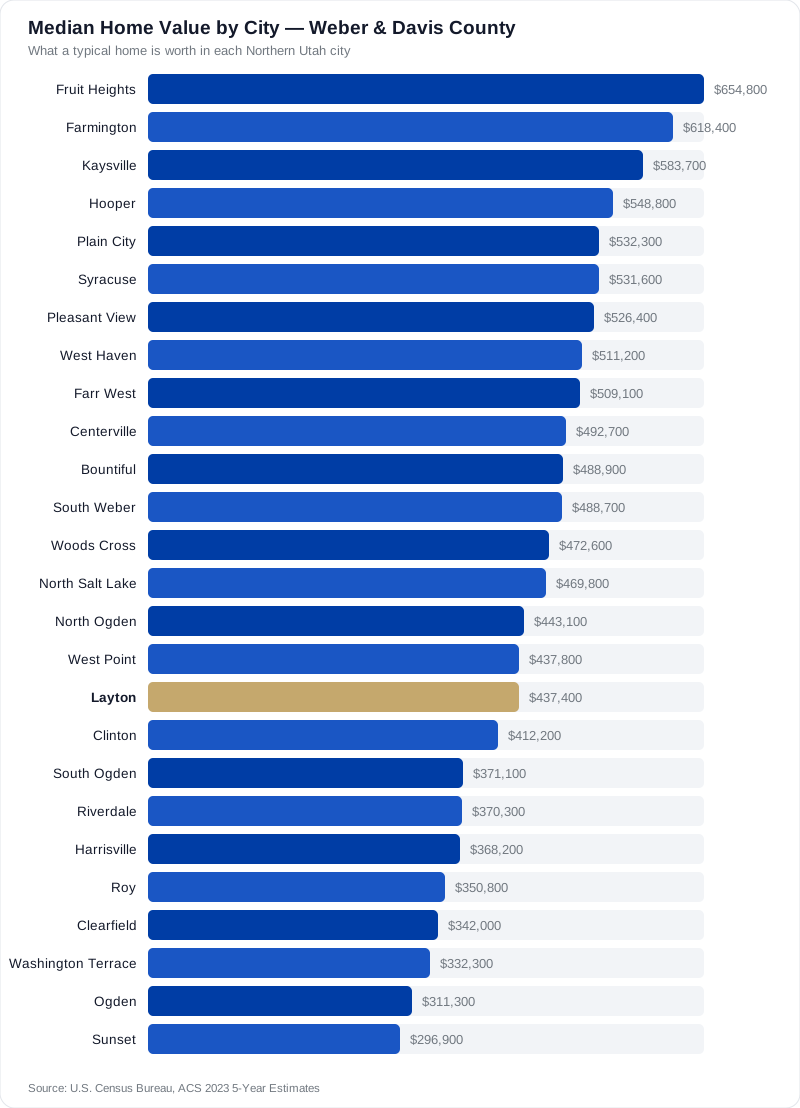
Compare the Davis County and Weber County hubs, then check what's actually for sale on live MLS listings.
How to make a VA offer sellers actually accept
Lead with a fully underwritten preapproval, a realistic closing date, and a clean inspection posture. The old belief that VA offers are weak is mostly a myth sellers still repeat.
Some listing agents still flinch at VA offers. Your job is to remove the excuse before they can use it.
What actually strengthens a VA offer:
- A fully underwritten preapproval, not a prequalification letter.
- A closing date that realistically accounts for VA appraisal turn times.
- Earnest money that signals you're serious.
- A short, specific inspection window.
- A brief cover note explaining your report date and why you're committed to closing.
Sellers can also pay some or all of your closing costs, and in a lot of deals that concession is worth more to you than shaving the price. The VA limits certain fees you're allowed to pay as the buyer — your lender will identify those on your loan estimate.
Don't waive the inspection to win. Finding out about a failing furnace in January in North Ogden is an expensive way to learn that the appraisal and the inspection are different documents.
Utah also runs state-level housing programs through Utah Housing Corporation. Those have their own rules and are worth a separate conversation with your lender.
Is a VA loan actually right for you? An honest answer
A VA loan is excellent if you're staying two or more years with stable income and little saved. It's a poor fit if you PCS within a year or want an investment property from day one.
I'd rather you rent than buy the wrong house on a short clock. Here's the honest breakdown.
A VA loan is likely right for you if:
- You expect at least two to three years at Hill AFB.
- You have limited savings — zero down and no monthly mortgage insurance is a genuine edge.
- Your BAH comfortably covers the payment in your target town.
- You want to build equity instead of writing rent checks to someone else.
A VA loan is probably not right for you if:
- You're separating or PCSing within roughly a year — transaction costs will likely eat any gain.
- Your credit or debt load won't clear lender underwriting yet. The VA guaranty does not override that.
- You want a pure rental property. Occupancy is required.
- This is a subsequent-use loan with nothing down and the 3.3% funding fee would strain the deal.
- You're stretching to the very top of your approval. Approved and affordable are different numbers.
There's one more honest case: if you have 20% saved and strong credit, ask your lender to run a conventional scenario side by side. Sometimes it beats the funding fee. More often it doesn't — but you should see both.
Not sure which camp you're in? Call me at (801) 603-5213 before you spend a dime. Bring your report date and we'll build the calendar backward from it, then narrow the map together using the Weber County and Davis County pages and live listings.
Thinking About a Move? Let's Talk.
Call Donald I. Gomez for straight answers on Northern Utah real estate — no pressure, just local help.
Frequently Asked Questions
How long do I have to serve before I can use a VA loan?
Is there a VA loan limit in Utah?
Can I buy a home in Utah before my PCS report date?
Do I have to pay the VA funding fee?
Can I rent out my Utah home when I PCS again?
What is a VA assumable loan and can I take one over in Utah?
Should I use a local lender or a national VA lender?
What if my spouse handles the whole purchase while I'm deployed?

Donald I. Gomez
Donald helps buyers, sellers, and PCSing military families move across Northern Utah — from Ogden to the Wasatch. A longtime Hill AFB-area local, he tours new builds and resale homes every week on his YouTube channel.