Yes, you can use a VA loan to buy a new construction home in Utah , and hundreds of Hill AFB families do it every year.
Key Takeaways
- Buying a builder home with a VA loan is routine — it is a normal VA purchase loan, closed once at the end.
- A true VA construction loan for building from bare dirt is legal but rare; few Utah lenders offer one.
- With full entitlement, the VA says you have no loan limit — the appraisal and your approval set the ceiling.
- The onsite sales rep works for the builder. Bring your own agent to the very first visit.
- Long build timelines create rate-lock and PCS-date risk. Plan for both before you sign anything.
See What's For Sale Right Now
Browse every active Northern Utah listing on a live map — updated straight from the MLS.
In this article
- Can I use a VA loan to buy a new construction home in Utah?
- The three ways new construction works with a VA loan
- What about a VA construction loan in Utah (building from dirt)?
- What the home and the builder have to meet
- What if the VA appraisal comes in low on a new build?
- Do I need my own agent to buy new construction?
- Should I use the builder's preferred lender?
- How much house can my VA loan cover on a new build?
- Does the VA funding fee change on new construction?
- Where are the new construction homes near Hill AFB?
- How do build timelines affect my rate lock and PCS date?
- Should you buy new construction with a VA loan, honestly?
Can I use a VA loan to buy a new construction home in Utah?
Yes. A VA loan buys new construction in Utah the same way it buys a resale home, as long as the house is finished by closing and meets VA property standards. It is a standard VA purchase loan.
When most military buyers near Hill Air Force Base say "new construction," they mean buying from a production builder. Either a finished spec home sitting in a subdivision, or a home partway through the build.
Both are ordinary VA purchase loans. You close once, at the end, when the house is done. The builder carries the construction costs, so you pay no interest while it is being framed.
Your eligibility does not change because the home is new. According to the U.S. Department of Veterans Affairs, current active-duty service members meet the minimum service requirement after at least 90 continuous days of service, without a break. National Guard and Reserve members qualify through 90 days of non-training active-duty service, or six creditable years of service.
What does change is everything around the loan: the contract you sign, the incentives you are offered, the appraisal timing, and how long you sit exposed to a moving interest rate. That is what the rest of this post covers.
The three ways new construction works with a VA loan
There are three paths: buy a completed spec home, sign on a home already under construction, or use a true VA construction loan to build from bare land. The first two are common in Utah. The third is rare.
Knowing which path you are on tells you what to worry about. A finished spec home behaves almost exactly like a resale. A to-be-built home puts months between your signature and your closing.
| Path | When you close | Who carries the cost during the build | How common near Hill AFB |
|---|---|---|---|
| Finished spec home | In weeks, like any resale | Builder (already done) | Very common |
| Home under construction (buy in progress) | When the home is complete | Builder | Very common |
| Build to suit on the builder's lot | Months out, when complete | Builder | Common |
| VA construction loan on your own land | One closing up front, then draws | You, through the loan | Rare |
For the first three, there is no such thing as a special VA new-construction product. You are getting a regular VA loan on a house that happens to be new.
That is good news. It means the same zero-down structure, the same lack of monthly mortgage insurance, and the same VA appraisal protections apply.
What about a VA construction loan in Utah (building from dirt)?
The VA does allow a one-time-close construction loan that finances land, construction, and the permanent mortgage in a single closing with no down payment. It exists, but very few Utah lenders offer it, and your builder must be VA registered.
This is the option people mean when they search va construction loan utah. It is the real thing: one closing, one set of costs, and the loan converts to a permanent VA mortgage when the house is finished.
The catch is supply. Most lenders do not write them, and the ones that do apply extra requirements. The builder generally has to be registered with the VA and carry a VA builder ID, and the plans, budget, and draw schedule all get reviewed before anything is signed. The VA home loans site is the place to start, and your lender will confirm the current program details.
The workaround most Utah buyers actually use: get a short-term construction loan from a local bank or credit union in your own name, then refinance into a VA loan once the certificate of occupancy is issued. That costs you two closings instead of one, and you carry the construction risk yourself.
If you are on a PCS timeline, this is usually the wrong path. Buying a builder's inventory home is faster and far less complicated.
What the home and the builder have to meet
The home must satisfy VA Minimum Property Requirements and pass a VA-assigned appraisal. On new construction, lenders typically want the certificate of occupancy issued and a builder warranty in place before they fund the loan.
VA Minimum Property Requirements are a safety and livability standard, not a quality standard. They are asking whether the home is safe, structurally sound, and sanitary, with working systems and safe access.
On a new build, that is rarely the sticking point. The house is brand new and had to pass city inspections to get its certificate of occupancy. Weber and Davis County cities each run their own building inspection process, and the builder handles that.
Here is the part people get wrong: a VA appraisal is not a home inspection, and a new home is not a flawless home. I have seen brand-new houses with backwards grading, missing attic insulation, and drains that were never connected.
- Hire an independent inspector for a pre-drywall inspection while the framing, wiring, and plumbing are still visible.
- Hire the same inspector again for a final walkthrough inspection before closing.
- Put every unfinished item on a written punch list tied to the builder warranty, not a verbal promise.
Two inspection fees on a new house feels unnecessary right up until it saves you five figures.
What if the VA appraisal comes in low on a new build?
The VA requires an Amendatory Escape Clause in your purchase contract. If the VA appraisal lands below the agreed price, you can walk away and get your earnest money back without penalty, even on a builder contract.
This protection matters more on new construction than on a resale, because of timing. You agree to a price today, but the appraisal happens near completion, sometimes many months later.
You are locking in a price against a market you cannot see yet. If values soften while your home is being built, the appraisal is where that shows up.
When it comes in low, you have the same choices as any buyer: the builder reduces the price, you bring cash for the difference, or you use the escape clause and leave. Builders resist price cuts because it affects the comps for every other home in the subdivision, so they will usually offer upgrades or closing-cost credits instead.
That is a real negotiation, and it is exactly the moment you want your own representation. Which brings us to the next point.
Do I need my own agent to buy new construction?
Yes. The onsite sales rep is paid by the builder and represents the builder's interests, not yours. Bring your own agent to the very first visit, because builder policies almost always require that first-visit registration.
This is the single most common mistake I see military buyers make in Davis and Weber County. You tour a model home on a Saturday, sign the visitor sheet alone, and quietly give up your representation for the entire transaction.
Many builders offer buyer-agent compensation, but the policies vary by builder and are typically conditioned on your agent being with you on that first visit. Walk in alone and you generally cannot add an agent later. The price does not drop either. The builder just keeps it.
What your own agent actually does on a new build:
- Reads the builder addendum, which is written by the builder's attorneys and is nothing like a standard Utah purchase contract.
- Pushes on which upgrades add appraised value and which are pure margin for the builder.
- Compares the builder incentive against outside lender pricing.
- Attends the pre-drywall and final walkthroughs and holds the punch list.
You can also compare builder inventory against resale homes in the same neighborhoods by browsing live MLS listings before you commit to anything.
Should I use the builder's preferred lender?
Sometimes, but never without comparing. Builders commonly tie closing-cost credits to their in-house lender. Get a Loan Estimate from an independent VA lender on the same day and compare the two line by line.
Builder incentives are real money, and I am not going to tell you to walk away from thousands in closing-cost credits out of principle.
But the incentive is only worth what it nets you. A credit that comes with a higher rate or heavier lender fees can quietly cost more over the years you own the home. The only honest way to know is a side-by-side Loan Estimate.
Request both estimates the same day, since pricing moves daily. Then compare three things: the interest rate, the total lender fees on page two, and the cash you need at closing.
One more thing worth asking directly: how many VA loans does this loan officer close in a year? A lender who mostly writes conventional loans can still do a VA loan, but the ones who do it constantly know how the funding fee, the escape clause, and entitlement restoration all interact without needing to look it up.
Free PCS to Utah Relocation Guide
Get my Hill AFB relocation packet — neighborhoods, VA loan tips, schools, and timelines — sent to your inbox.
How much house can my VA loan cover on a new build?
With full entitlement, the VA states there is no VA loan limit. You can borrow what you can afford, as long as the appraisal supports the price and your lender approves your credit, income, debts, and assets.
That is straight from the VA loan limits page, and it matters on new construction because builder upgrades push your price up after you have already picked the floor plan.
If you have partial or remaining entitlement, the math is tighter. The VA calculates your available entitlement using the county one-unit conforming loan limit multiplied by .25, minus the entitlement you have already used. Basic entitlement is $36,000, and VA loan limits are the same as the Federal Housing Finance Agency conforming loan limits. Most lenders then require entitlement, a down payment, or a combination to cover at least 25% of the total loan amount.
Entitlement deserves its own full breakdown, so I will leave it there. The practical takeaway for a new build is simple: if you are using partial entitlement, know your ceiling before you sit down at the design center. Twenty thousand in upgrades can change what you are required to bring to closing.
Does the VA funding fee change on new construction?
No. The funding fee is based on your down payment and whether it is your first VA loan, not on whether the home is new. First use with less than 5% down is 2.15%.
According to the VA funding fee page, the purchase loan rates effective April 7, 2023 are:
- First use: 2.15% with less than 5% down, 1.5% with 5% or more down, 1.25% with 10% or more down.
- Subsequent use: 3.3% with less than 5% down, 1.5% with 5% or more down, 1.25% with 10% or more down.
Notice the jump on subsequent use with nothing down. If this is your second VA loan and you have some cash, putting 5% down cuts the fee from 3.3% to 1.5%. On a builder purchase where you are already negotiating credits, that is worth running the numbers on.
The fee can be financed into the loan rather than paid in cash. Just remember that financing it increases your loan amount, which matters if the appraisal is already tight against your contract price. Some borrowers are exempt from the funding fee entirely; the VA page above lists who qualifies.
Where are the new construction homes near Hill AFB?
Most new-build inventory sits west and north of the base. In Davis County, look at Syracuse, West Point, and Clinton. In Weber County, look at West Haven, Farr West, and Plain City.
The geography here is simple: the mountains cap growth on the east bench, so new subdivisions push west toward the lake and north up the corridor. That is where the buildable land is.
On the Davis County side, buyers searching for davis county new homes for sale usually end up in Syracuse, West Point, or Clinton, all an easy commute to the base. Davis County also has newer pockets in Layton and Kaysville, though land there is scarcer and priced accordingly.
On the Weber side, West Haven has been the biggest growth story, with Farr West and Plain City close behind. Browse the full Weber County hub to compare.
Prices vary a lot city to city, and new construction usually carries a premium over comparable resale in the same area. Here is how median home values compare across the region:
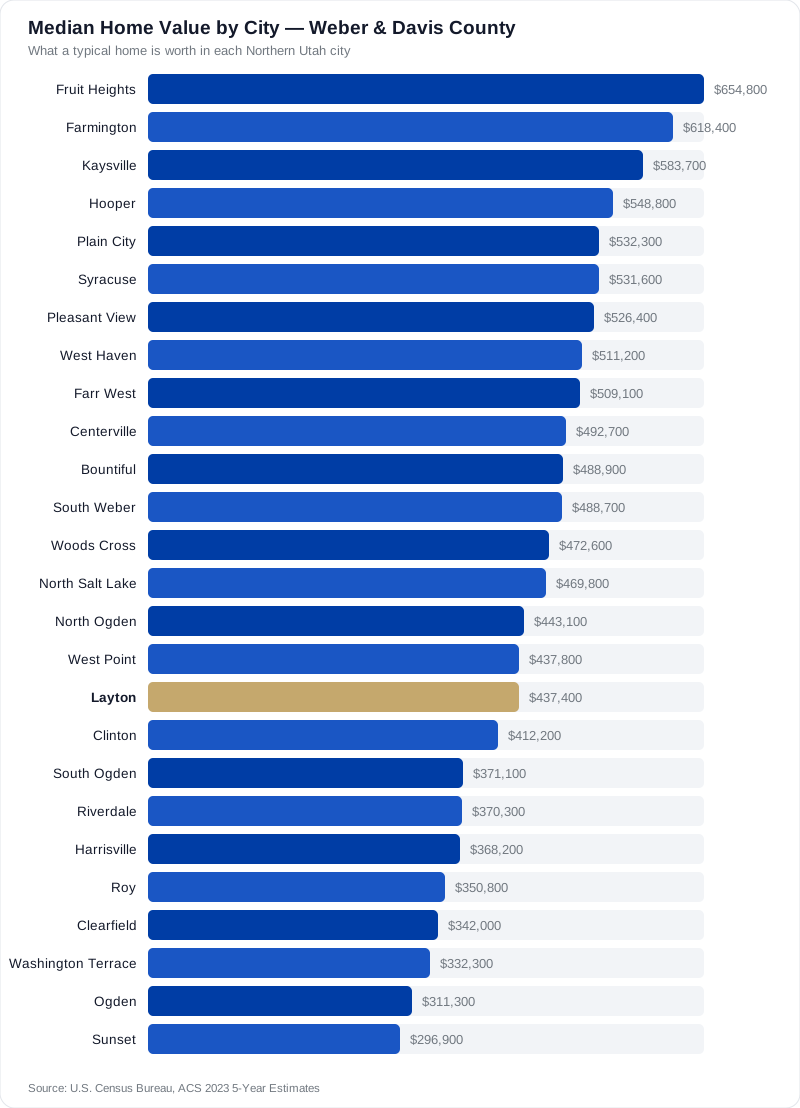
Those are owner-reported values from the U.S. Census Bureau and reflect all housing stock, not just new builds, so treat them as a relative guide between cities rather than a price for any specific home.
How do build timelines affect my rate lock and PCS date?
Build timelines run months, and standard rate locks are usually shorter. Ask about extended locks and float-down options before signing, and never assume the builder's completion date is firm.
This is the risk nobody flags at the design center. You sign in spring, the home finishes in fall, and your loan gets priced against whatever the market is doing then.
Extended rate locks exist, and so do float-down options that let you capture a lower rate if the market improves. Both usually cost something, and the terms vary by lender. Ask about them in writing before you sign the builder contract, not after.
The second risk is your report date. Builder completion dates slip for weather, inspections, and supply issues, and the builder addendum usually protects the builder when that happens. If you are inbound on orders, ask yourself what happens if the house is 45 days late:
- Where do you and your household goods live in the gap?
- How long can you stay in temporary lodging?
- Does your contract give you any remedy for a late delivery, or none at all?
Our PCS relocation guide for Hill AFB walks through sequencing a move around a closing date, and the free 208-page relocation guide covers the full timeline.
Should you buy new construction with a VA loan, honestly?
New construction is a great fit if you have flexible timing, want a warranty and low maintenance, and can absorb a delay. It is a poor fit if you are on a tight PCS clock or need seller-paid closing costs.
Who it works well for:
- You have months of runway before you need to be in the house.
- You want a builder warranty and no deferred maintenance for the length of a typical assignment.
- You are buying in a growing subdivision and plan to stay past the early phases.
- You have flexible housing in the meantime, on base or on a month-to-month lease.
Who it does not work for, and I tell people this regularly:
- You report in six weeks. A resale closing you control beats a builder date you do not.
- You need every dollar of closing help. Builders often prefer upgrades over cash concessions.
- You may PCS again in two years. Selling in a subdivision where the builder is still selling new inventory next door is hard, because you are competing against a company that can discount.
- You want mature trees, a finished yard, and fencing on day one. Landscaping is often on you, and it is not cheap in Utah.
If you are still deciding, walk two builder communities and two resale homes in the same city on the same weekend. The difference gets obvious fast.
Thinking About a Move? Let's Talk.
Call Donald I. Gomez for straight answers on Northern Utah real estate — no pressure, just local help.
Frequently Asked Questions
Can I use a VA loan to build a house from scratch in Utah?
Does the home have to be finished before I close with a VA loan?
Will builders in Davis County accept a VA loan?
Do I need a down payment on a new construction VA loan?
What happens if the VA appraisal is lower than the builder's price?
Should I get a home inspection on a brand-new house?
Can I lock my interest rate before the home is finished?
How do I get started without losing my buyer representation?

Donald I. Gomez
Donald helps buyers, sellers, and PCSing military families move across Northern Utah — from Ogden to the Wasatch. A longtime Hill AFB-area local, he tours new builds and resale homes every week on his YouTube channel.