If you have full VA entitlement, there is no VA loan limit in Utah — only what you can afford. Here is how VA loan limits and eligibility requirements in Utah actually work for Hill AFB families.
Key Takeaways
- Full VA entitlement means no loan limit — affordability and the appraisal set your ceiling instead.
- Active duty qualifies after 90 continuous days; Guard and Reserve after 90 days or six creditable years.
- The 2026 FHFA baseline conforming limit is $832,750, and Weber and Davis counties use it.
- Partial entitlement math: county limit × .25, minus entitlement already used. Basic entitlement is $36,000.
- On a subsequent use, 5% down cuts the funding fee from 3.3% to 1.5%.
See What's For Sale Right Now
Browse every active Northern Utah listing on a live map — updated straight from the MLS.
In this article
- VA loan limits and eligibility requirements in Utah: the short version
- Who qualifies: the actual service requirements
- Your Certificate of Eligibility is the document that proves it
- What full entitlement means and why it removes the limit
- The 2026 conforming loan limit that applies in Weber and Davis counties
- How the math works when you have partial or remaining entitlement
- Restoring entitlement and using a VA loan twice during a PCS
- The VA funding fee and what it costs you
- Eligibility is not approval: what your lender still checks
- VA assumable loans in Utah: the underused option
- Occupancy rules, deployments, and PCS timing
- When a VA loan is the right call — and when it is not
VA loan limits and eligibility requirements in Utah: the short version
With full entitlement there is no VA loan limit. The VA says you can borrow what you can afford if the appraisal supports the price. Limits only apply to partial entitlement, based on your county's conforming loan limit.
Almost every confused conversation I have about VA loans starts in the same place. Someone read a number online and assumed it was a ceiling on what they could buy.
It usually is not. According to the U.S. Department of Veterans Affairs, a borrower with full entitlement has no VA loan limit. You do not have a loan limit as long as you can afford the loan amount and the property appraisal supports the purchase price.
That is the whole headline. The limits people quote are for borrowers with partial or remaining entitlement — someone who already has a VA loan out, or who lost one to foreclosure. That is a real and common situation around Hill Air Force Base, where families PCS in already owning a house somewhere else.
Two things still gate you regardless of entitlement. The VA has to agree you're eligible, and your lender has to approve you on credit, income, debts, and assets. The VA is explicit about that second part — no entitlement status overrides underwriting.
Who qualifies: the actual service requirements
Active-duty members qualify after at least 90 continuous days of service without a break. National Guard and Reserve members qualify through 90 days of non-training active-duty service, or six creditable years of service.
The VA's eligibility rules spell out a minimum service requirement, and the current-service version is shorter than most people expect.
- Currently serving active duty: at least 90 continuous days of service — all at once, without a break in service.
- National Guard and Reserve: 90 days of non-training active-duty service, or six creditable years of service.
Note the word continuous. Ninety days broken into two chunks does not satisfy the active-duty minimum. This trips up people who add up total time served rather than a single unbroken stretch.
Veterans who have separated fall under service-length rules tied to when they served and how they were discharged. Surviving spouses of service members who died in the line of duty or from a service-connected disability may also be eligible. Those categories have their own documentation paths, and the VA page above is the source of truth — not a lender's marketing sheet, and not a forum post.
If you are still deciding whether Northern Utah is even the right landing spot, our PCS relocation guide for Hill AFB covers the geography before you get into loan mechanics.
Your Certificate of Eligibility is the document that proves it
The Certificate of Eligibility (COE) is the VA's official confirmation that you qualify and shows your entitlement status. Most lenders pull it electronically in minutes; you can also request it yourself through VA.gov.
Eligibility is a status. The COE is the paperwork that proves the status, and no lender will finalize a VA loan without it.
Three ways to get one:
- Ask your lender to pull it through the VA's automated system. This is fastest and usually happens during pre-approval.
- Request it yourself through your account on VA.gov.
- Submit the request by mail with supporting documents.
What you'll need depends on your status. Separated veterans generally need their DD-214. Active-duty members need a statement of service signed by the appropriate command authority. Guard and Reserve members need records covering their qualifying service.
Pull your COE before you shop, not after you find a house. I have watched buyers lose a home in Layton because their statement of service took nine days to route through the orderly room while another offer got accepted. The document is free. Get it early and get it out of the way.
The COE also tells you something useful: how much entitlement you have left, which is the number that determines whether any limit applies to you at all.
What full entitlement means and why it removes the limit
You have full entitlement if you have never used your VA home loan benefit, or if you used it and have since repaid the loan in full and sold the property. Full entitlement means no VA loan limit.
Entitlement is the VA's guaranty to your lender. Because that guaranty replaces the down payment a conventional lender would demand, the amount of entitlement you have available drives everything.
You generally have full entitlement in two situations: you have never used the benefit, or you used it, repaid the loan in full, and no longer own that property.
With full entitlement, the VA does not cap you. Your real ceiling is set by three other things:
- What you can afford. Your lender's income, debt, and residual income analysis.
- What the appraisal supports. If the VA appraiser values the home below the contract price, that gap becomes your problem, not the VA's.
- What the seller will accept. A financing type is only as good as the offer around it.
The practical result in Weber and Davis counties is that the loan limit is almost never the thing standing between a full-entitlement buyer and a house. Payment comfort is. When someone tells me they're worried about the VA cap on a $520,000 house in Syracuse, we are usually solving the wrong problem.
The 2026 conforming loan limit that applies in Weber and Davis counties
For 2026 the FHFA baseline conforming loan limit for one-unit properties is $832,750 in most of the country. Weber and Davis counties are not high-cost areas, so the baseline applies, not the $1,249,125 high-cost ceiling.
The VA does not publish its own separate table. According to the VA, VA home loan limits are the same as Federal Housing Finance Agency conforming loan limits, so the county one-unit conforming limit is the figure that matters for partial entitlement.
Per the Federal Housing Finance Agency, the 2026 baseline for one-unit properties is $832,750 — up $26,250 from $806,500 in 2025, reflecting a 3.26% average national house price increase between the third quarter of 2024 and the third quarter of 2025. The high-cost area ceiling for 2026 is $1,249,125.
Weber and Davis counties are not high-cost areas. The baseline is your number here.
Now put that against what homes actually cost locally. The chart below shows how median home values vary across Weber and Davis county cities, and the spread between the west-side communities and the Davis County bench is wide.
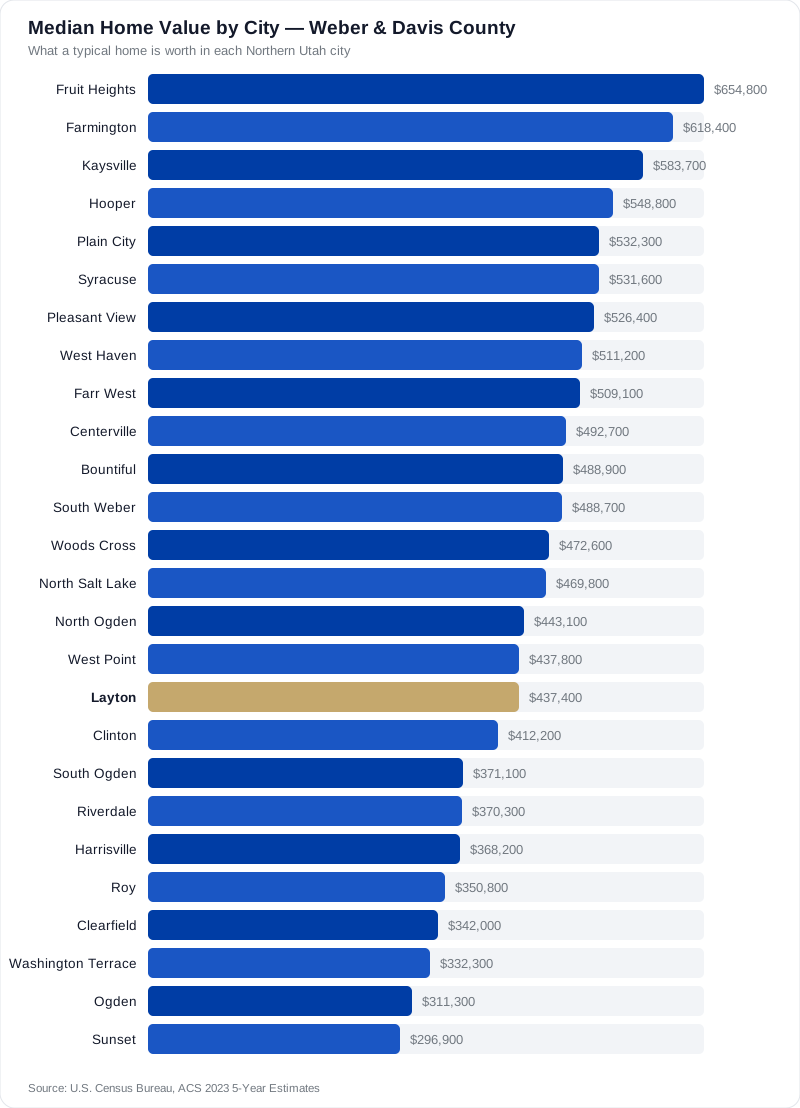
For most buyers here, even a partial-entitlement calculation built on $832,750 lands well above the price range they're actually shopping. Browse live MLS listings and you'll see why.
How the math works when you have partial or remaining entitlement
The VA multiplies your county one-unit conforming loan limit by .25, then subtracts entitlement you already used. Most lenders require entitlement, down payment, or a combination covering at least 25% of the total loan amount.
This is where the arithmetic actually matters. Per the VA, with partial or remaining entitlement the calculation is county one-unit conforming limit × .25, minus the entitlement you have already used. Basic entitlement is $36,000.
Using the 2026 baseline of $832,750, that first step comes to about $208,187 of maximum guaranty in Weber or Davis county. Subtract whatever is currently tied up in a VA loan you still have, and what's left is your remaining guaranty.
Then apply the lender rule: entitlement plus down payment must generally cover at least 25% of the total loan amount. Work that backwards and remaining guaranty times four is roughly your zero-down ceiling.
A worked example, illustrative only: if $70,000 of entitlement is committed to a house you kept in another state, roughly $138,187 remains. Multiply by four and you are near $552,750 with nothing down. Above that, you cover the shortfall in cash rather than being told no.
Two cautions. Lender overlays differ, and your COE is the only authoritative statement of what you have used. Have your loan officer run your actual numbers before you set a price range.
Restoring entitlement and using a VA loan twice during a PCS
Selling the home and paying the loan in full restores entitlement. You can also keep the first home and buy again with remaining entitlement — a common move for service members PCSing into Hill AFB.
This is the single most useful thing for military families to understand, because PCS orders do not wait for a real estate market.
Your paths generally look like this:
- Sell and pay off. The loan is satisfied, you no longer own the property, and your entitlement comes back for full use.
- Keep the first home and use what's left. Rent out the old house, buy here with remaining entitlement, and apply the .25 formula above to the new county's limit.
- One-time restoration. The VA allows a one-time restoration in a specific scenario where the loan is paid in full but you still own the property. This one has conditions — ask the VA or your lender directly rather than assuming you qualify.
- A qualified veteran assumes your loan and substitutes their own entitlement, which releases yours.
The third and fourth options get misdescribed constantly online. Confirm them through the VA, not a lender ad.
Practically, a lot of incoming Hill families keep the last house, rent it, and buy in Clearfield or Layton with remaining entitlement. It works. It just requires knowing your number first.
Free PCS to Utah Relocation Guide
Get my Hill AFB relocation packet — neighborhoods, VA loan tips, schools, and timelines — sent to your inbox.
The VA funding fee and what it costs you
Most borrowers pay a one-time funding fee set as a percentage of the loan. For a first use with less than 5% down it is 2.15%; subsequent use with less than 5% down is 3.3%. The fee can be financed.
There is no monthly mortgage insurance on a VA loan. Instead there is a one-time funding fee, and the rate depends on your down payment and whether this is your first use.
Per the U.S. Department of Veterans Affairs, these purchase-loan rates took effect April 7, 2023:
| Down payment | First use | Subsequent use |
|---|---|---|
| Less than 5% | 2.15% | 3.3% |
| 5% or more | 1.5% | 1.5% |
| 10% or more | 1.25% | 1.25% |
Read that table twice, because it contains a real planning decision. On a subsequent use, putting down 5% cuts the fee from 3.3% to 1.5%. On a hypothetical $450,000 loan that difference is roughly $8,100 — often more than the 5% down payment costs you in monthly payment terms over a short ownership window.
The fee can be financed into the loan rather than paid at closing. And some borrowers are exempt entirely, including veterans receiving compensation for a service-connected disability, Purple Heart recipients serving on active duty, and certain surviving spouses. Check the VA page above for the exemption list.
Eligibility is not approval: what your lender still checks
The VA guarantees the loan; a lender funds it. The VA sets no minimum credit score, but lenders set their own. You still qualify on credit, income, debts, assets, and residual income, and the property must appraise.
The VA is direct about this. Even with full entitlement and no loan limit, the lender must still approve you on credit, income, debts, and assets.
A few things worth knowing:
- Credit score. The VA does not publish a minimum. Lenders impose their own overlays, and they vary a lot. A turndown at one lender is not a turndown at all of them — worth remembering before you give up.
- Residual income. This is a VA-specific test looking at what's left each month after major obligations, and it varies by region and household size. It's part of why VA loans perform well.
- The appraisal. A VA appraiser establishes value and checks Minimum Property Requirements — safe water and sewer, working heat, sound roof and structure, no obvious safety hazards.
- Condos. The project generally has to be VA-approved. Verify before you write on one.
Two practical local notes. Fixer-uppers in older Ogden neighborhoods sometimes trip MPRs, and a low appraisal is negotiated between buyer and seller — the VA does not fill the gap. Plan for both.
VA assumable loans in Utah: the underused option
VA loans are assumable with lender and VA approval. A buyer can take over the seller's existing rate and terms. But unless the buyer is an eligible veteran substituting entitlement, the seller's entitlement stays tied to that property.
A VA assumable loan in Utah lets a buyer step into the seller's existing mortgage — same rate, same remaining term. When older loans carry rates well below what is currently on offer, that is worth real money.
Here is what people miss. The assumption does not have to be by another veteran — a civilian buyer can assume a VA loan with approval. But that is exactly where the seller gets hurt.
If the buyer is not an eligible veteran substituting their own entitlement, the seller's entitlement stays tied up in that property until the loan is paid off. The seller has sold the house and still can't use the benefit again. I have seen that discovered after closing. It is not fixable at that point.
Other realities of assumption:
- The servicer and the VA must approve the assuming buyer's credit and income. It is not automatic.
- The buyer must cover the difference between the sale price and the remaining loan balance, in cash or through a second lien. On a home with substantial equity that gap can be large.
- Assumptions take longer to process than a standard purchase. Build the timeline into your offer.
Occupancy rules, deployments, and PCS timing
A VA purchase loan requires you to certify intent to occupy the home as your primary residence. The VA provides exceptions for service members, including allowing a spouse to satisfy occupancy while the member is deployed.
The VA home loan is for primary residences. You certify intent to occupy the home yourself within a reasonable time after closing. It is not a vehicle for buying rentals or vacation homes.
Military life obviously does not respect that neatly, so the VA built in accommodations. The most important one for Hill families: a spouse can satisfy the occupancy requirement while the service member is deployed. There are also provisions for members on active duty away from the property. The current rules live on the VA's housing assistance site — confirm your situation there or with your lender before you sign anything.
What the rules do allow, and what confuses people: once you have genuinely occupied the home and are later reassigned, renting it out is normal. That is how families end up with a house in Ohio and a house in Davis County.
Timing advice from someone who does this locally: start the loan file before your report date, not after. Our free 208-page PCS and relocation guide lays out the sequence so the loan and the orders don't collide.
When a VA loan is the right call — and when it is not
A VA loan is usually the strongest option for buyers with limited cash and full entitlement. It is often the wrong tool for funding-fee-paying buyers with large down payments, condo shoppers, heavy fixer-uppers, and investment purchases.
I will not pretend the VA loan wins every time. Here is the honest split.
It is usually the right call when:
- You have full entitlement and limited cash — no down payment and no monthly mortgage insurance is hard to beat.
- You are funding-fee exempt. At that point it is close to unbeatable.
- You want the appraisal and MPR review acting as a backstop on an unfamiliar market you're buying into sight-unseen.
It is often the wrong tool when:
- You are putting 20% or more down and paying a funding fee. Run the conventional comparison — the fee may cost more than the mortgage insurance you're avoiding.
- You are buying a condo that is not VA-approved, or a home with real condition problems that will fail MPRs.
- You want a second home or a rental. Occupancy rules rule it out.
- You're on a subsequent use with tight remaining entitlement and a conventional loan gets you into a better house with the same cash.
The right answer depends on your entitlement, your cash, and the specific property. Look at what's actually listed in Weber County and Davis County, then call (801) 603-5213 and we'll pressure-test the financing before you write.
Thinking About a Move? Let's Talk.
Call Donald I. Gomez for straight answers on Northern Utah real estate — no pressure, just local help.
Frequently Asked Questions
Is there a maximum VA loan amount in Utah?
What is the VA loan limit for Weber County and Davis County in 2026?
How long do I have to serve before I can use a VA loan?
Can I have two VA loans at the same time?
Are VA loans assumable in Utah?
Does the VA require a minimum credit score?
Do I have to pay the VA funding fee?
How do I know if a VA loan is the right move for my Northern Utah purchase?

Donald I. Gomez
Donald helps buyers, sellers, and PCSing military families move across Northern Utah — from Ogden to the Wasatch. A longtime Hill AFB-area local, he tours new builds and resale homes every week on his YouTube channel.