Utah property taxes surprise most buyers — in a good way. The state exempts 45% of your primary home's value before the rate ever hits, and here's what that actually costs in Weber and Davis County.
Key Takeaways
- Utah exempts 45% of a primary home's value — you're taxed on just 55%.
- 2025 rates in Weber & Davis County run roughly 0.87% to 1.24%, varying by tax area.
- A median Layton home costs about $2,292/year; a median Roy home about $1,989.
- Rate alone misleads — Ogden's highest rate produces one of the lowest bills.
- Quick estimate: multiply purchase price by 0.0055, then verify the parcel.
See What's For Sale Right Now
Browse every active Northern Utah listing on a live map — updated straight from the MLS.
In this article
- How Utah Property Taxes Work in One Paragraph
- How Are Utah Property Taxes Calculated? The Actual Math
- Utah Property Taxes by City: Weber and Davis County Compared
- Are Utah Property Taxes High? Honestly, No
- The Primary Residential Exemption: The Rules That Trip People Up
- Why Your Bill Changes Even When the Rate Falls
- How to Pay Utah Property Taxes Online in Weber and Davis County
- How Property Taxes Land in Your Monthly Payment
- Who Should Actually Let Property Taxes Drive Their Decision
- What Hill AFB Families Need to Know About Utah Property Taxes
- How to Appeal Your Assessment If the Value Looks Wrong
- Building Utah Property Taxes Into Your Purchase Budget
How Utah Property Taxes Work in One Paragraph
Your county assesses your home's market value, exempts 45% of it if it's your primary residence, then applies your local tax rate to the remaining 55%. That single exemption is why Utah property taxes feel lower than the rate suggests.
Most states tax you on the full assessed value of your home. Utah does not.
According to the Utah State Tax Commission, the primary residential exemption removes 45% of a primary residence's fair market value from taxation. Only the remaining 55% is taxable. The authority for it sits in Utah Code 59-2-102 and 59-2-103 and in Article XIII, Section 3 of the Utah Constitution.
So the sticker rate you see on a tax notice is misleading if you compare it straight across to another state. A 1% Utah rate on a primary home is functionally about 0.55% of market value.
The exemption covers the home plus up to one acre of land. If your lot is bigger than an acre, the extra ground is taxed at full value.
How Are Utah Property Taxes Calculated? The Actual Math
Market value multiplied by 0.55 gives taxable value. Taxable value multiplied by your tax-area rate gives your annual tax. Three numbers, one calculation — no assessment ratios or homestead formulas to decode.
Here is the formula, start to finish:
- Market value — what the county assessor says your home is worth as of January 1.
- Taxable value = market value × 0.55 (primary residence only).
- Annual tax = taxable value × your tax-area rate.
Run it on a real house. A Layton home at the Census median value of $437,400 has a taxable value of $240,570. Apply Layton's most common 2025 tax-area rate of 0.9527% and you get roughly $2,292 for the year, per the Utah State Tax Commission's 2025 Tax Rates by Tax Area.
That's about $191 a month folded into your payment. For a lot of buyers moving here from California, Texas, or Virginia, that number lands lower than they budgeted for.
One thing to hold onto: rates are set by tax area, not by city. A single city can contain several slightly different rates depending on which school, water, fire, and sewer districts a parcel falls inside. The figures in this post are the most common rate for each city.
Utah Property Taxes by City: Weber and Davis County Compared
For the 2025 tax year, typical rates in Weber and Davis County run from about 0.87% in Plain City to about 1.24% in Ogden. Applied to 55% of median home values, most annual bills land between $1,800 and $3,600.
Below are 2025 Final Adopted Rates from the Utah State Tax Commission, applied to each city's median home value. Each rate shown is that city's most common tax-area rate — rates vary by tax area within every one of these cities.
| City | County | 2025 rate (typical) | Median home value | Taxable (55%) | Approx. annual tax |
|---|---|---|---|---|---|
| Plain City | Weber | 0.8746% | $532,300 | $292,765 | ~$2,561 |
| South Weber | Davis | 0.9498% | $488,700 | $268,785 | ~$2,553 |
| Layton | Davis | 0.9527% | $437,400 | $240,570 | ~$2,292 |
| Kaysville | Davis | 0.9625% | $583,700 | $321,035 | ~$3,090 |
| Hooper | Weber | 0.9885% | $548,800 | $301,840 | ~$2,984 |
| Fruit Heights | Davis | 0.9887% | $654,800 | $360,140 | ~$3,561 |
| West Haven | Weber | 0.9948% | $511,200 | $281,160 | ~$2,797 |
| Bountiful | Davis | 1.0102% | $488,900 | $268,895 | ~$2,716 |
| Farmington | Davis | 1.0124% | $618,400 | $340,120 | ~$3,443 |
| Roy | Weber | 1.0307% | $350,800 | $192,940 | ~$1,989 |
| Syracuse | Davis | 1.0365% | $531,600 | $292,380 | ~$3,031 |
| Clinton | Davis | 1.0400% | $412,200 | $226,710 | ~$2,358 |
| Farr West | Weber | 1.0420% | $509,100 | $280,005 | ~$2,918 |
| Washington Terrace | Weber | 1.0532% | $332,300 | $182,765 | ~$1,925 |
| West Point | Davis | 1.0671% | $437,800 | $240,790 | ~$2,569 |
| Pleasant View | Weber | 1.0910% | $526,400 | $289,520 | ~$3,159 |
| Sunset | Davis | 1.0963% | $296,900 | $163,295 | ~$1,790 |
| Clearfield | Davis | 1.1159% | $342,000 | $188,100 | ~$2,099 |
| North Ogden | Weber | 1.1302% | $443,100 | $243,705 | ~$2,754 |
| South Ogden | Weber | 1.1320% | $371,100 | $204,105 | ~$2,310 |
| Harrisville | Weber | 1.1677% | $368,200 | $202,510 | ~$2,365 |
| Ogden | Weber | 1.2402% | $311,300 | $171,215 | ~$2,123 |
Notice what the table shows: the highest-rate city on the list, Ogden, produces one of the lower annual bills because home values there are lower. Rate alone tells you very little.
Browse Weber County communities and Davis County communities to see how these towns actually differ day to day.
Are Utah Property Taxes High? Honestly, No
Utah's effective property tax burden on owner-occupied homes is on the low end nationally. The 45% residential exemption is the reason — it cuts the effective rate on your home's full market value nearly in half.
Compare apples to apples. A 1.03% Utah rate sounds similar to a 1.03% rate in another state. But in Utah that rate only touches 55% of your value, so your effective rate against market value is about 0.57%.
That's the piece out-of-state buyers miss when they run quick comparisons online. Plenty of national calculators skip the exemption entirely and quote you a number that's nearly double what you'll actually pay.
Where Utah gets expensive is home prices, not property tax. Farmington's median home value of $618,400 and Kaysville's $583,700 are the real budget pressure — the tax on top is comparatively modest.
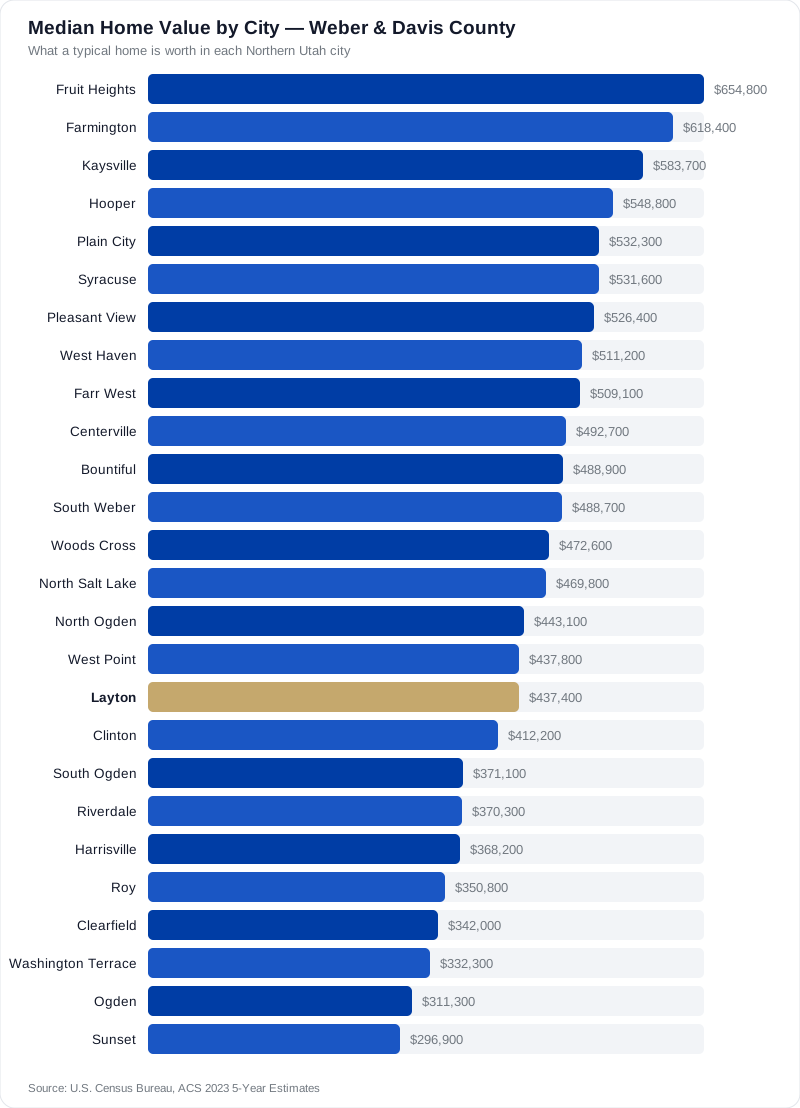
Since your tax bill is driven by value as much as rate, that spread in home values explains most of the spread in tax bills.
The Primary Residential Exemption: The Rules That Trip People Up
You get the 45% exemption on one household residence plus up to one acre. Property that becomes residential mid-year qualifies if used as a primary residence 183 or more consecutive days that year.
The Utah State Tax Commission spells out the boundaries, and they matter more than most buyers expect:
- One per household. You cannot claim the exemption on a primary home and a second home at the same time.
- 183 consecutive days. If a property becomes residential partway through the year, it still qualifies as long as it was used as a primary residence for 183 or more consecutive calendar days in that year.
- One acre cap. The exemption covers the residence and up to one acre. Larger parcels — common out in Huntsville, Hooper, and the west-side ag areas — have the excess land taxed separately.
- Transient use is excluded. Short-term and transient residential use doesn't qualify, and condominiums enrolled in a rental pool are specifically excluded.
If you buy mid-year, ask the title company and your county assessor how the exemption is being applied for that tax year. Don't assume it carried over automatically from the seller.
Why Your Bill Changes Even When the Rate Falls
Utah uses Truth in Taxation. When property values rise, the certified rate is lowered so taxing entities collect about the same revenue as last year. Your bill moves based on how your value changed relative to everyone else's.
This is the single most misunderstood thing about Utah property taxes, and it explains almost every angry phone call I get in the fall.
Utah's system is revenue-based, not rate-based. If values across a school district jump 10%, the certified rate drops so the district still collects roughly last year's dollars. A taxing entity that wants more than that has to hold a public Truth in Taxation hearing and vote for it in the open.
The practical effect on you:
- Your value rose faster than the area average → your bill goes up.
- Your value rose slower than average → your bill can actually go down.
- Your value rose right at average → your bill stays roughly flat.
So "my home value went up 12% and my taxes only went up 2%" isn't a mistake. That's the system working the way it was designed.
How to Pay Utah Property Taxes Online in Weber and Davis County
Both Weber County and Davis County accept online property tax payments through their Treasurer's offices, usually by eCheck or credit card. Card payments typically carry a third-party convenience fee; eCheck is usually cheaper or free.
Here's the practical sequence:
- Find your parcel number. It's on your annual valuation notice and your tax bill, and it's also searchable on your county's property records site.
- Go to your county Treasurer's online payment page. Weber County and Davis County each run their own portal — start from the county's official .gov site, not a search ad.
- Choose eCheck over card if you can. Card processors add a percentage fee on a bill that may run over $3,000. On a $3,000 bill, even a small percentage fee is real money.
- Check escrow first. If your lender escrows taxes, they pay it directly. Paying it yourself on top creates a refund headache, not a bonus.
Utah bills property tax annually on a calendar year with a single fall due date, not in installments. Your county Treasurer publishes the exact due date on your notice every year — read that line, don't guess it.
The State of Utah's official portal links out to each county's offices if you're not sure which site is legitimate.
Free PCS to Utah Relocation Guide
Get my Hill AFB relocation packet — neighborhoods, VA loan tips, schools, and timelines — sent to your inbox.
How Property Taxes Land in Your Monthly Payment
Most lenders collect one-twelfth of your annual tax bill each month and hold it in escrow. Divide the annual figures in this post by 12 to see the monthly impact on your payment.
Run it on the cities buyers ask me about most:
- Clearfield at ~$2,099/year → about $175/month
- Roy at ~$1,989/year → about $166/month
- Layton at ~$2,292/year → about $191/month
- Syracuse at ~$3,031/year → about $253/month
- Kaysville at ~$3,090/year → about $258/month
That's roughly a $90/month swing between a median Roy home and a median Kaysville home — before you account for the price difference between them. It's not nothing, but it's rarely the thing that decides a purchase.
Two escrow realities worth knowing. First, your first-year escrow is an estimate; if the county's number comes in higher, your servicer adjusts your payment and may bill a shortage. Second, new construction is the classic trap — the first year's tax is often assessed on the bare lot, so your escrow is set low and jumps hard once the finished home is assessed.
Ask your builder and your lender directly whether the escrow estimate is based on land only or the completed home. I ask that question on every new-build deal I write.
Who Should Actually Let Property Taxes Drive Their Decision
Property taxes should shape your choice if you're stretching your budget, buying above $600,000, or staying long-term. They should not drive it if the gap between two cities is under about $50 a month.
Let me be straight with you, because this is where people overthink it.
Taxes should matter to your decision if:
- You're buying near the top of your approval and every $100/month counts.
- You're shopping above $600,000, where a 0.2% rate difference is a few hundred dollars a year.
- You're on a fixed income and want the most predictable long-term carrying cost.
- You're comparing two genuinely similar homes in different tax areas — that's the one case where the rate is a clean tiebreaker.
Taxes should NOT drive your decision if:
- The difference between your two finalists is under about $50 a month. Commute, schools, and lot quality will matter far more over ten years.
- You're a military family expecting to PCS in three years. Resale demand beats a small rate edge every time.
- You'd be buying a worse house in a worse location just to shave the rate. I've watched buyers do this and regret it inside a year.
Honestly? In most Weber and Davis County matchups, the tax difference is the smallest variable on the table. Buy the right house in the right place, then optimize the tax. Not the other way around.
What Hill AFB Families Need to Know About Utah Property Taxes
Buying near Hill AFB, you'll pay tax through escrow like any homeowner. Utah offers abatements for veterans with service-connected disability and for active-duty members — apply through your county, not the state.
If you're PCSing into Hill Air Force Base, the housing decision usually comes down to Layton, Clearfield, Roy, Syracuse, and South Weber. All five sit in a fairly narrow band — 0.9498% in South Weber up to 1.1159% in Clearfield for the 2025 tax year.
Three things I tell every military client:
- Utah has abatement programs for veterans with a service-connected disability and for active-duty service members. The amounts and deadlines are set in statute and administered county by county — call the Weber County or Davis County Clerk/Auditor and ask directly. I won't quote you a dollar figure that may have changed.
- If you rent the home out when you PCS, the exemption picture changes. Long-term rentals can still be residential property, but transient and rental-pool use is excluded, and the exemption is one per household. Call your assessor before you list it.
- VA loan borrowers still escrow taxes. No down payment doesn't mean no tax. That's a separate topic — see the VA's home loan page for loan mechanics.
My full PCS relocation guide for Hill AFB walks through the neighborhood-by-neighborhood tradeoffs, and the free 208-page relocation guide covers the rest of the move.
How to Appeal Your Assessment If the Value Looks Wrong
You appeal the assessor's market value, not the tax rate. File with your county Board of Equalization by the published deadline, and bring comparable sales — a recent purchase price is your strongest evidence.
You cannot appeal a tax rate. Rates come out of Truth in Taxation and budget hearings. What you can challenge is the county's opinion of what your home is worth.
The strongest cases I see:
- You just bought it. An arm's-length purchase price is the best single piece of evidence there is. If the county's value is well above what you paid, that's a real appeal.
- The property record is wrong. Wrong square footage, a finished basement that isn't finished, a bathroom that doesn't exist. Fix the record and the value follows.
- Comparable sales disagree. Recent nearby sales of similar homes coming in materially lower.
Deadlines are firm and published on your annual valuation notice by your county Board of Equalization. Miss the window and you wait a full year.
If you need recent comparable sales for an appeal, I'll pull them from the MLS for you. That's a five-minute favor, not a listing pitch. You can also start by browsing live listings to see what's actually selling near you.
Building Utah Property Taxes Into Your Purchase Budget
Estimate at roughly 0.55% of purchase price for a primary residence in most of Weber and Davis County, then verify the exact tax-area rate on the specific parcel before you write the offer.
A quick field method that gets you close: multiply purchase price by 0.0055. That's a ~1% rate applied to 55% of value, which is the middle of the range for both counties.
On a $450,000 home, that's about $2,475 a year, or roughly $206 a month. Close enough for a first pass at a budget.
Then verify before you commit. The steps:
- Pull the parcel's actual tax-area rate from the Utah State Tax Commission's tax area rate publication or from the county Treasurer.
- Confirm the residential exemption is being applied for the tax year you're buying in.
- On new construction, ask whether the escrow estimate reflects land only or the finished home.
- Check for special assessment areas — some newer subdivisions carry additional district levies inside their tax area rate.
Household income context matters too. Kaysville's median household income is $128,996 and Layton's is $99,188, per the U.S. Census Bureau — so a $3,090 Kaysville bill and a $2,292 Layton bill land differently on the households that actually live there.
Want the real number on a specific address instead of an estimate? Call or text me at (801) 603-5213 and I'll pull the parcel, the tax area, and the current assessed value before you write an offer.
Thinking About a Move? Let's Talk.
Call Donald I. Gomez for straight answers on Northern Utah real estate — no pressure, just local help.
Frequently Asked Questions
Are property taxes high in Utah compared to other states?
How much is property tax on a $500,000 home in Weber County?
Does Utah waive property taxes for disabled veterans?
Can I pay my Utah property taxes online?
Why did my property tax bill go up when the rate went down?
Do I lose the residential exemption if I rent my house out during a PCS?
When are Utah property taxes due?
Which Weber or Davis County city has the lowest property taxes?

Donald I. Gomez
Donald helps buyers, sellers, and PCSing military families move across Northern Utah — from Ogden to the Wasatch. A longtime Hill AFB-area local, he tours new builds and resale homes every week on his YouTube channel.