Utah first time home buyer programs are not a myth — Ogden City will lend you $10,000 to $20,000 at 0% interest, deferred until you sell. Here is who actually qualifies and how to claim it.
Key Takeaways
- Own in Ogden lends $10,000-$20,000 at 0% interest, deferred until you sell or refinance.
- Ogden police officers and firefighters can get $20,000 — forgiven after 10 years of service and occupancy.
- Utah Housing down payment assistance is a second loan tied to a Utah Housing first mortgage.
- Income caps matter: Own in Ogden tops out at 80% of area median income.
- You must occupy the home. Non-occupant co-borrowers are not eligible for Own in Ogden.
See What's For Sale Right Now
Browse every active Northern Utah listing on a live map — updated straight from the MLS.
In this article
- Does Utah Offer First-Time Home Buyer Programs?
- Own in Ogden: $10,000 to $20,000 in Down Payment Help
- Own in Ogden Requirements: Income Caps and Occupancy
- When Do You Repay the Own in Ogden Loan?
- How Utah Housing Corporation Down Payment Assistance Works
- Utah Housing vs. Own in Ogden: Which One Fits You?
- Why First-Time Buyers Target Ogden and Weber County
- What Renters in Weber and Davis County Should Know
- Where Else to Look for Utah Down Payment Assistance
- How to Actually Get the Money: A Step-by-Step
- Who Should Skip Utah First-Time Buyer Assistance?
- Do You Even Have to Be a First-Time Buyer?
Does Utah Offer First-Time Home Buyer Programs?
Yes. Utah has both statewide and city-level help. Utah Housing Corporation offers down payment assistance as a second loan, and cities like Ogden run their own programs — Own in Ogden lends $10,000 to $20,000 at 0% interest.
There is no single "state of Utah first time home buyer program" with one application. That is the first thing people get wrong. Assistance in Utah comes from two different levels, and they work very differently.
The statewide layer is Utah Housing Corporation (UHC), a public corporation that funds mortgages and pairs them with down payment assistance. According to Utah Housing Corporation, their down payment assistance is structured as a second loan that is only available in combination with a Utah Housing first mortgage — you cannot bolt it onto an outside lender's loan.
The local layer is city money. Here in Weber County, Ogden City runs Own in Ogden, and it is one of the more generous municipal programs in the state. Other cities and counties along the Wasatch Front operate their own programs with their own rules and their own funding cycles.
The practical takeaway: you shop programs by where you are buying, not just by who you are. A buyer looking in Ogden has a different menu than one looking in Kaysville.
Own in Ogden: $10,000 to $20,000 in Down Payment Help
Own in Ogden is Ogden City's down payment assistance program — a 0% interest, deferred-payment loan of $10,000 for general buyers, $15,000 for K-12 teachers and Ogden City employees, and $20,000 for Ogden City police and firefighters.
This is the headline program in Weber County, and it is genuinely strong. According to Ogden City, Own in Ogden is a 0% interest, deferred-payment loan — meaning no monthly payment on the assistance and no interest accruing on it.
The amount depends on who you are:
- $10,000 — general buyers
- $15,000 — K-12 teachers and administrators, plus Ogden City employees
- $20,000 — sworn Ogden City police officers and firefighters
Ogden City also notes that the program is open for home closings occurring on or after July 1, 2026. That date matters if you are timing an offer — confirm the current cycle with the city before you write.
One detail that gets missed: this is a loan, not a grant, for most people. It sits quietly as a second lien until a triggering event. More on that below.
Own in Ogden Requirements: Income Caps and Occupancy
Own in Ogden caps household income at 80% of area median income — for a single-person household, maximum gross income is $66,050. You must contribute at least $500 of your own money and occupy the home as your primary residence.
These are the three rules that decide whether you are in or out, straight from Ogden City:
- Income cap. Your household cannot exceed 80% of area median income. For a single-person household, the maximum gross income is $66,050. Larger households get higher limits — ask the city for the current chart for your household size.
- Your own skin in the game. The borrower must contribute a minimum of $500. That is not a huge number, but it is not zero, and it has to be documented.
- Owner occupancy. You must live in the home as your primary residence. Non-occupant borrowers are not eligible — so a parent co-signing who will not live there is a problem, not a solution.
That third rule is where I see deals blow up. A buyer stretches to qualify by adding a co-borrower who lives in Salt Lake, and the assistance evaporates. Structure the loan application around the occupancy rule from day one, not after you are under contract.
Look at the income math against real Ogden prices. The U.S. Census Bureau's ACS 2023 5-Year Estimates put Ogden's median household income at $70,053 and median home value at $311,300. A single earner under $66,050 is squarely in the target zone for this program in this city.
When Do You Repay the Own in Ogden Loan?
Repayment is due when you sell the home, refinance the mortgage, or stop using it as your primary residence. For sworn Ogden City police officers and firefighters, the repayment requirement expires after 10 years of continued owner-occupancy and city employment.
This is the question every buyer asks second, right after "how much." Per Ogden City, three events trigger repayment:
- You sell the home
- You refinance the mortgage
- The home stops being your primary residence
Notice what is not on that list: making payments. There are none. The balance just sits there at 0% until one of those three things happens.
The refinance trigger is the sneaky one. If rates drop and you want to refinance, that assistance loan comes due. Plan for it. Some buyers are fine with that; others would rather take a slightly different structure knowing they may refinance in a few years.
And the best deal in the program: for sworn Ogden City police officers and firefighters, the repayment requirement expires after 10 years of continued owner-occupancy and continued Ogden City employment. Stay ten years, and that $20,000 is effectively yours. That is one of the strongest first responder housing incentives on the Wasatch Front.
How Utah Housing Corporation Down Payment Assistance Works
Utah Housing Corporation offers down payment assistance as a second loan, available only in combination with a Utah Housing first mortgage. Credit scores above 620 are permitted, and you apply through a UHC-approved participating lender.
Utah Housing Corporation is the statewide engine for Utah down payment assistance programs. Here is what Utah Housing Corporation actually states about the mechanism:
- The assistance is a second loan, layered behind your first mortgage.
- It is available only with a Utah Housing first mortgage. You cannot pair it with your credit union's loan or a national lender's loan.
- Credit scores above 620 are permitted, and a higher credit score may qualify you for a lower monthly payment.
- UHC now also offers a Deferred Down Payment Assistance option.
- You qualify through a Utah Housing approved participating lender — not by applying to UHC directly.
You will see third-party mortgage blogs quote exact assistance percentages and program-by-program credit minimums. I am not going to repeat numbers I cannot confirm on Utah Housing's own site. Get the current terms from a participating lender or from UHC directly, because they change.
The "must use a Utah Housing first mortgage" rule is the single biggest thing to understand. Pick your lender before you fall in love with a house — if your lender is not a UHC participating lender, this door is closed.
Utah Housing vs. Own in Ogden: Which One Fits You?
Own in Ogden gives a fixed dollar amount but only inside Ogden city limits. Utah Housing works anywhere in Utah but locks you into a Utah Housing first mortgage. Some buyers can stack them — ask both.
These programs solve different problems, and the right answer depends on where you are buying and what your credit looks like.
| Own in Ogden | Utah Housing Corporation | |
|---|---|---|
| Where it works | Ogden city limits only | Statewide |
| Form of help | 0% interest deferred loan | Second loan (deferred option available) |
| Amount | $10,000 / $15,000 / $20,000 by occupation | Confirm current terms with UHC |
| First mortgage | Your choice of lender | Must be a Utah Housing first mortgage |
| Income limit | 80% of area median income | Confirm current limits with UHC |
| Credit | Set by your first mortgage lender | Above 620 permitted |
| Occupancy | Required; no non-occupant borrowers | Confirm with participating lender |
Sources: Ogden City and Utah Housing Corporation.
If you are buying in Ogden and your income fits under 80% AMI, start with Own in Ogden. It is fixed, generous, and does not dictate your first mortgage. If you are buying in Layton, Clearfield, or anywhere outside Ogden, Utah Housing is your statewide path.
Why First-Time Buyers Target Ogden and Weber County
Ogden's median home value was $311,300 in the 2023 Census ACS estimates — the lowest of the major Weber and Davis County cities. That price gap is why first-time buyer dollars stretch furthest here.
If you are a first time home buyer in Ogden Utah, you are shopping the most affordable entry point on this stretch of the Wasatch Front — and you happen to be in the one city with a $10,000-$20,000 assistance program.
Here is the spread across the market, per the U.S. Census Bureau's ACS 2023 5-Year Estimates:
- Ogden: median home value $311,300, median household income $70,053
- Clearfield: $342,000 value, $75,429 income
- Roy: $350,800 value, $91,112 income
- Layton: $437,400 value, $99,188 income
- North Ogden: $443,100 value, $107,425 income
- Bountiful: $488,900 value, $103,723 income
- Kaysville: $583,700 value, $128,996 income
- Farmington: $618,400 value, $120,432 income
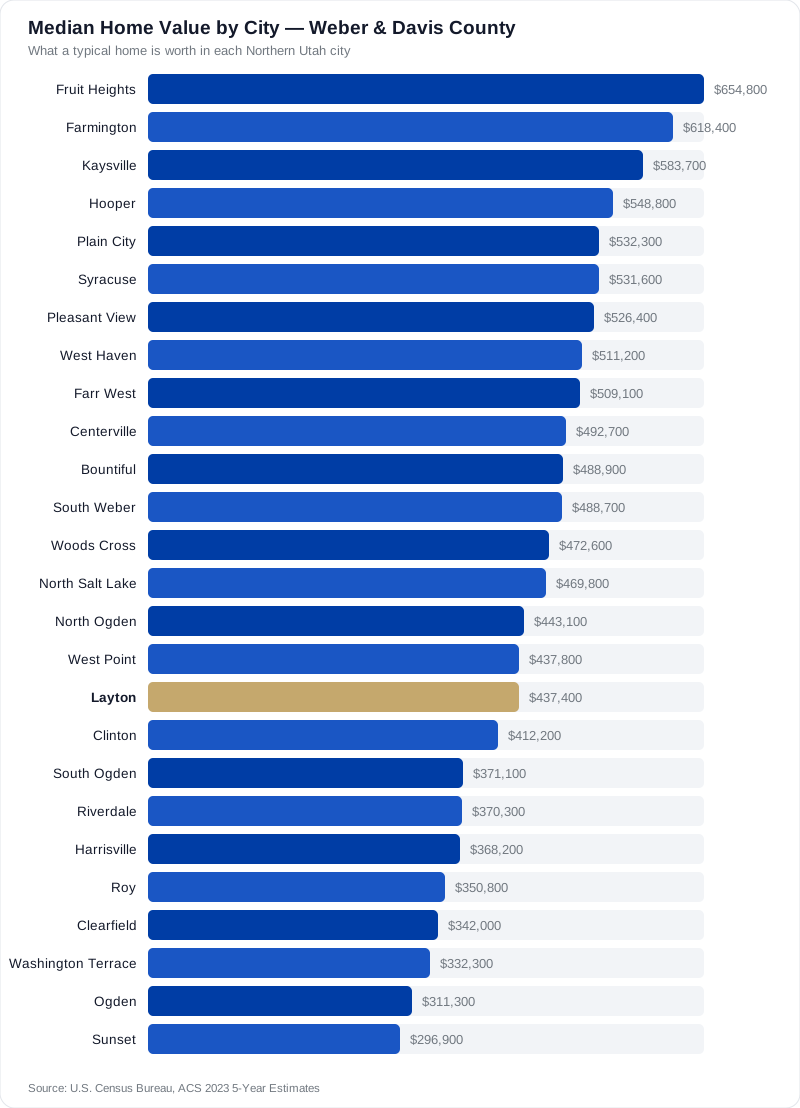
Look at the gap between Ogden and Farmington — roughly $307,000 in median value. That is not a small difference in what your assistance dollars buy you. A $10,000 deferred loan is a meaningful chunk of an Ogden down payment. It is a rounding error on a Farmington house.
Browse what is actually on the market right now on our live MLS listing search, and compare neighborhoods across Weber County and Davis County.
Free PCS to Utah Relocation Guide
Get my Hill AFB relocation packet — neighborhoods, VA loan tips, schools, and timelines — sent to your inbox.
What Renters in Weber and Davis County Should Know
Median gross rent in Ogden was $1,128 in the 2023 Census ACS estimates, versus $1,557 in Roy and $1,459 in Clearfield. If you are already paying north of $1,400, assistance can close the gap to owning.
Most first-time buyers I work with are not short on income. They are short on the lump sum. That is exactly the problem down payment assistance was built for.
Per the U.S. Census Bureau's ACS 2023 5-Year Estimates, median gross rent runs $1,128 in Ogden, $1,459 in Clearfield, $1,455 in Layton, $1,557 in Roy, and $1,467 in Bountiful.
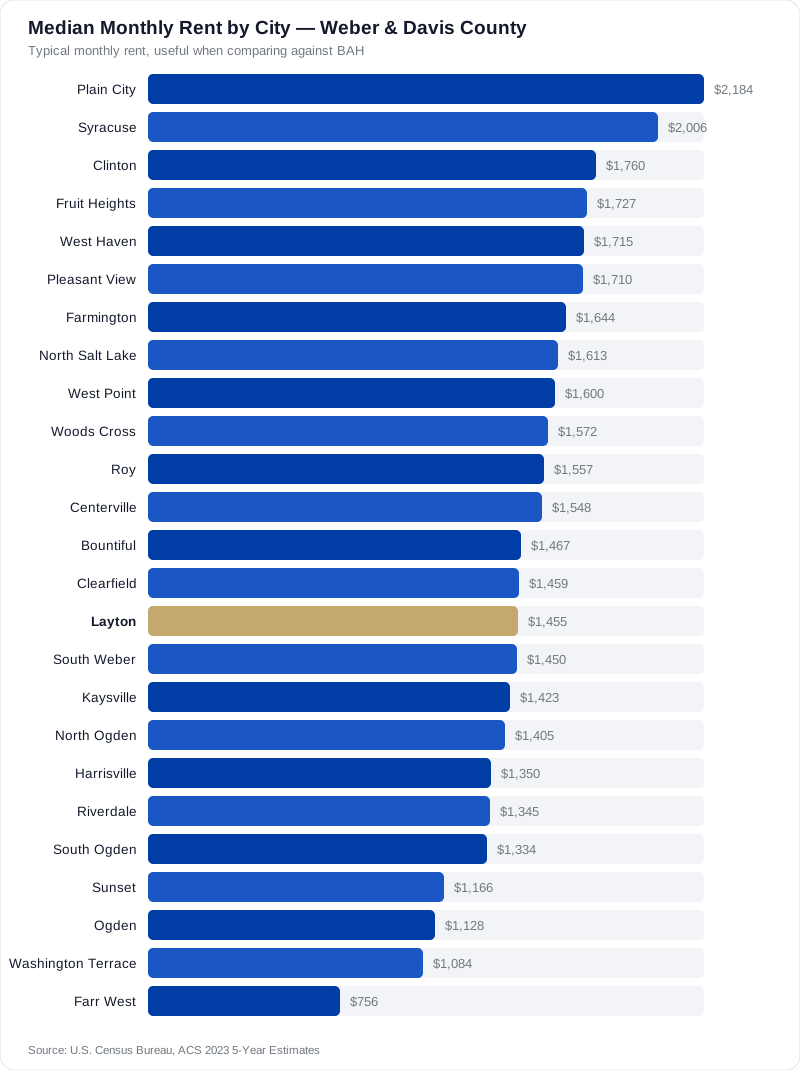
If you are writing a $1,500 rent check in Roy every month, the monthly payment on a home may not be the obstacle you think it is. The obstacle is the cash to get in the door.
That is the whole point of a 0% deferred loan. It bridges the cash gap without adding a monthly payment on top of your mortgage.
Where Else to Look for Utah Down Payment Assistance
Beyond Utah Housing and Own in Ogden, check your city and county housing departments, your employer, and your credit union. Programs are funded in cycles and often go unclaimed simply because nobody local asked.
Buyers ask me about "CDC Utah down payment assistance" and "down payment assistance Utah County" all the time. Here is the honest framework: assistance is hyper-local and it changes.
Where to actually look:
- Your city's community development department. Ogden publishes Own in Ogden at ogdencity.gov. Other cities post theirs the same way.
- Your county. County housing offices administer federal pass-through dollars. Start at utah.gov to find the right county office.
- Utah Housing Corporation participating lenders. A good UHC lender knows which local programs stack with which loan products.
- Your employer. Ogden City employees get $15,000 through Own in Ogden. School districts, hospitals, and large employers sometimes have their own.
- Nonprofit housing counselors. HUD-approved counseling agencies operate along the Wasatch Front and often know about money that never gets advertised.
One warning. Do not trust dollar figures you read on a national mortgage blog. Those posts get scraped, republished, and go stale. Verify every number against the city, county, or UHC page before you build an offer around it.
How to Actually Get the Money: A Step-by-Step
Confirm your income against the program cap, get pre-approved with a lender who works with that program, get the program's own approval in writing, then write your offer with the assistance timeline built into your closing date.
Order matters here more than anywhere else in the buying process. Do it in this sequence:
- Check the income cap first. Five minutes. For Own in Ogden, a single-person household maxes out at $66,050 gross. If you are over, stop and pivot to other options.
- Pick the right lender. For Utah Housing assistance you need a UHC approved participating lender and a Utah Housing first mortgage. For Own in Ogden, you need a lender who has actually closed one before.
- Get pre-approved before you shop. Not pre-qualified. Pre-approved.
- Apply to the assistance program. Get the city or UHC approval in hand — in writing — before you are under contract.
- Write the offer with realistic timing. Assistance programs add review steps. A 21-day close will not work. Your agent needs to negotiate a closing date that survives the paperwork.
- Document the $500. Own in Ogden requires a minimum $500 borrower contribution. Have it seasoned in your account and sourced.
Step 5 is where I earn my keep. Sellers reject assistance offers when the timeline looks shaky, not because they dislike the program. A clean, well-structured offer with a realistic close date wins.
Who Should Skip Utah First-Time Buyer Assistance?
Skip it if you plan to move or refinance within a few years, if a non-occupant co-borrower is essential to qualify, if you earn above the income cap, or if the required first mortgage costs more than the help is.
I would rather lose a deal than put you in a bad structure. Here is who should walk away from these programs.
You are moving in two or three years. Repayment triggers on sale. If you take $10,000 and sell in 24 months into a flat market, you may hand it all back at closing with little equity to cushion it. Military families on short assignments at Hill Air Force Base should run this math carefully — our PCS relocation guide for Hill AFB walks through the short-timeline scenario.
You expect to refinance soon. Refinancing triggers repayment on Own in Ogden. If your plan hinges on refinancing out of a high rate in 18 months, the assistance may cost you flexibility you need more than cash.
You need a non-occupant co-borrower. Own in Ogden explicitly excludes them. If a parent must be on the loan and will not live there, this program is off the table — build a different plan.
Your income is over the cap. Do not try to engineer around it. Over is over, and misrepresenting income on a government-funded program is a much bigger problem than a bigger down payment.
The required first mortgage is worse than your alternative. Utah Housing assistance requires a Utah Housing first mortgage. If your credit is strong and you have a better first mortgage available elsewhere, run the total cost both ways before you chase the assistance. Sometimes the help costs more than it gives. A good lender will show you both columns without flinching.
Veterans and active-duty buyers have a separate path worth pricing side by side — a VA home loan may require no down payment at all, which changes the calculus entirely. That is its own topic and its own post.
Do You Even Have to Be a First-Time Buyer?
Not always. Many Utah programs define a first-time buyer as someone who has not owned a primary residence in the past three years, and some local programs have no first-time requirement at all — only income and occupancy limits.
This trips up more people than any other rule. "First-time buyer" is a term of art, not plain English.
In most housing programs, it means you have not owned a primary residence within the past three years. So if you owned a home, divorced or relocated, and have rented for four years, you may be a first-time buyer again. Ask. Do not assume you are disqualified.
Some local programs do not even use a first-time test. Ogden City's published Own in Ogden requirements center on income at or below 80% of area median income, a $500 minimum contribution, and owner occupancy — per Ogden City.
The lesson: let the program tell you if you are eligible instead of disqualifying yourself. I have seen buyers rule themselves out over a rule that did not apply to the program they were looking at.
Not sure which category you fall in? Call me at (801) 603-5213 and we will figure it out in one conversation. You can also grab our free 208-page relocation and buying guide if you would rather read first.
Thinking About a Move? Let's Talk.
Call Donald I. Gomez for straight answers on Northern Utah real estate — no pressure, just local help.
Frequently Asked Questions
What is the Utah first time home buyer program?
Is there a Utah first time home buyer $20,000 program?
What are the Own in Ogden income requirements?
Can I use Utah Housing down payment assistance with my own lender?
Do I have to pay back down payment assistance in Utah?
Can my parents co-sign if they are not going to live in the house?
What credit score do I need for Utah down payment assistance?
How do I find homes in Ogden that fit these programs?

Donald I. Gomez
Donald helps buyers, sellers, and PCSing military families move across Northern Utah — from Ogden to the Wasatch. A longtime Hill AFB-area local, he tours new builds and resale homes every week on his YouTube channel.