Everyone wants to know if the Ogden Utah housing market is about to drop. Here's the honest answer, backed by real Census numbers, and how to decide without trying to time the bottom.
Key Takeaways
- A broad Northern Utah price crash is unlikely. Small, local price softening can happen.
- Ogden had the lowest 2024 median home value of eight cities we compared: $355,600.
- Layton's 2024 median home value was $477,700, about $122,000 more than Ogden's.
- Your rate and your monthly payment usually matter more than a small change in price.
- Buy when your timeline, budget, and job all line up. Don't buy because of a market forecast.
See What's For Sale Right Now
Browse every active Northern Utah listing on a live map — updated straight from the MLS.
In this article
- Will Utah Housing Prices Go Down?
- What the Census Data Says About the Ogden Utah Housing Market
- Why a Northern Utah Housing Market Crash Is Unlikely
- What Could Actually Push Prices Down
- The Housing Market in Layton Utah vs. Ogden
- Which Northern Utah Cities Look Most Stretched?
- Utah First Time Home Buyer Interest Rates: Why Rate Beats Price
- Is It a Good Time to Buy a House in Utah? Who Should and Shouldn't
- Waiting for a Price Dip: The Real Math
- How to Read the Northern Utah Market Yourself
- What This Means for Hill AFB and PCS Buyers
- The Bottom Line on the Ogden Utah Housing Market
Will Utah Housing Prices Go Down?
Probably not across the board. Northern Utah has limited land, steady demand, and a big employment base around Hill AFB. Some neighborhoods and price ranges can soften, but a region-wide crash is unlikely.
Here's the short version. Prices can flatten or dip in pockets without the whole region crashing. Those are very different things, and headlines tend to blur them together.
In Northern Utah, a "dip" usually looks like price cuts on listings that were priced too high. You'll also see sellers paying some closing costs, and homes sitting a few extra weeks. It rarely looks like values falling off a cliff.
Nobody can promise where prices go next, and you should be skeptical of anyone who says they can. What you can do is understand what holds prices up here and what could push them down. Then you make a decision that works whichever way the market moves.
What the Census Data Says About the Ogden Utah Housing Market
According to the U.S. Census Bureau's ACS 2024 5-Year Estimates, Ogden's median home value was $355,600, the lowest of eight Northern Utah cities compared here. Farmington was highest at $650,700.
The best free, consistent data on home values comes from the U.S. Census Bureau. Its American Community Survey (ACS) 2024 5-Year Estimates show a wide price spread across Weber and Davis Counties.
| City | Median Home Value | Median Household Income | Median Gross Rent | Population |
|---|---|---|---|---|
| Ogden | $355,600 | $72,575 | $1,216 | 87,413 |
| Clearfield | $373,900 | $75,495 | $1,579 | 33,523 |
| Roy | $383,000 | $91,282 | $1,624 | 38,993 |
| North Ogden | $476,600 | $113,722 | $1,638 | 21,947 |
| Layton | $477,700 | $102,480 | $1,538 | 83,286 |
| Bountiful | $532,200 | $104,785 | $1,565 | 45,023 |
| Kaysville | $623,700 | $133,026 | $1,538 | 33,053 |
| Farmington | $650,700 | $127,338 | $1,769 | 25,389 |
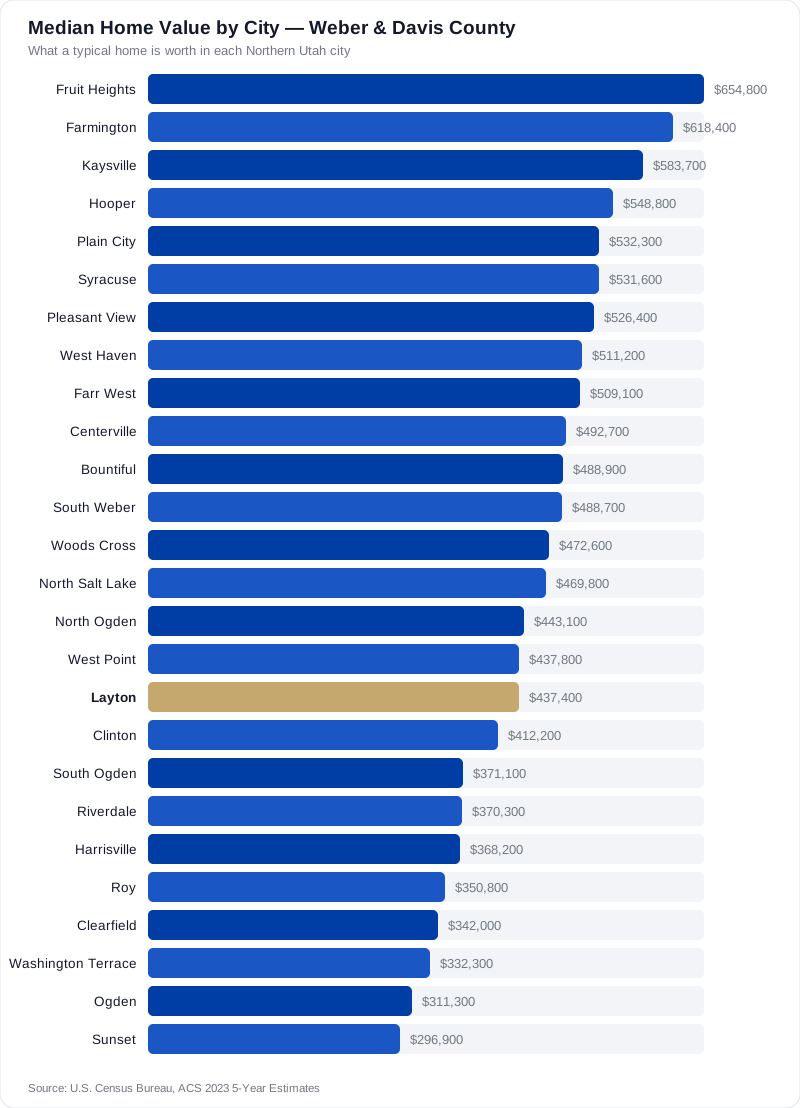
One important caveat. A 5-year estimate blends survey responses over several years and reports what homeowners think their home is worth. It's a great way to compare cities to each other. It is not a live read on today's list prices. For that, check current MLS listings.
Why a Northern Utah Housing Market Crash Is Unlikely
Three things hold prices up: geography that limits buildable land, steady job-driven demand anchored by Hill Air Force Base, and a large pool of buyers waiting for the right payment.
The northern Utah housing market has some built-in support that many other markets lack.
- Geography. The Wasatch Mountains sit on one side and the Great Salt Lake wetlands on the other. There's only so much flat, buildable land between them. New growth keeps pushing west into places like West Haven, Hooper, and Syracuse.
- Jobs. Hill Air Force Base is a major employer, and it brings a steady stream of military and civilian families who need housing. That demand doesn't vanish when rates go up.
- Pent-up buyers. Many people who wanted to buy have been waiting on the sidelines. When payments ease even a little, some of them come back into the market, and that tends to put a floor under prices.
A real crash usually needs forced selling. That means lots of owners who have to sell and can't. Most Northern Utah owners have built equity, and many locked in their loans years ago. That makes a wave of distressed sales less likely.
What Could Actually Push Prices Down
Local prices could soften if rates rise sharply, if a major employer cuts jobs, if a burst of new construction outpaces demand in one area, or if sellers simply price above what buyers will pay.
Being honest means naming the risks, too. These are the forces that could cool prices in parts of Weber and Davis Counties:
- Higher mortgage rates. When rates rise, buyers qualify for less. Sellers eventually have to meet them where they are.
- Job losses. A major layoff or big shift in defense spending would hit demand, especially in the cities closest to the base.
- New-build competition. Where builders deliver a lot of homes at once, they may offer incentives. Resale homes nearby then have to compete on price.
- Overpricing. The most common "price drop" is a seller cutting from an unrealistic list price. That's a correction to the listing, not to the market.
Notice what's missing from that list: a region-wide collapse. The likely downside scenario here is a slower market with more negotiating room, not a crash.
The Housing Market in Layton Utah vs. Ogden
Layton's 2024 median home value was $477,700, compared with Ogden's $355,600, according to Census ACS data. Layton households also earned more, with a median income of $102,480 versus $72,575 in Ogden.
Buyers often compare these two, and they really are different markets. Layton is newer, sits right next to Hill AFB's south gate area, and has a lot of 1990s-and-newer subdivisions. Ogden has older housing stock, historic neighborhoods, and more homes at lower price points.
The Census numbers show the gap. Layton's median home value runs about $122,000 higher than Ogden's. That's roughly in line with the income difference. Both cities have populations above 80,000, so neither is a small-town outlier.
What this means for you: if prices soften, older homes that need updating tend to feel it first, and that's common in Ogden. Move-in-ready homes in popular Layton school areas tend to hold up better. Neither one is "safer." They just attract different buyers. For a broader view, see the Davis County community guide.
Which Northern Utah Cities Look Most Stretched?
Using Census ACS 2024 figures, Farmington has the highest home-value-to-income ratio of the eight cities, at about 5.1. Roy and North Ogden are essentially tied for the lowest, at about 4.2, which means values there sit closest to what local incomes support.
One simple way to check whether prices are running ahead of local paychecks is to divide median home value by median household income. Here's what the Census ACS 2024 numbers show (our math, rounded):
- North Ogden: about 4.2
- Roy: about 4.2
- Layton: about 4.7
- Kaysville: about 4.7
- Ogden: about 4.9
- Clearfield: about 5.0
- Bountiful: about 5.1
- Farmington: about 5.1
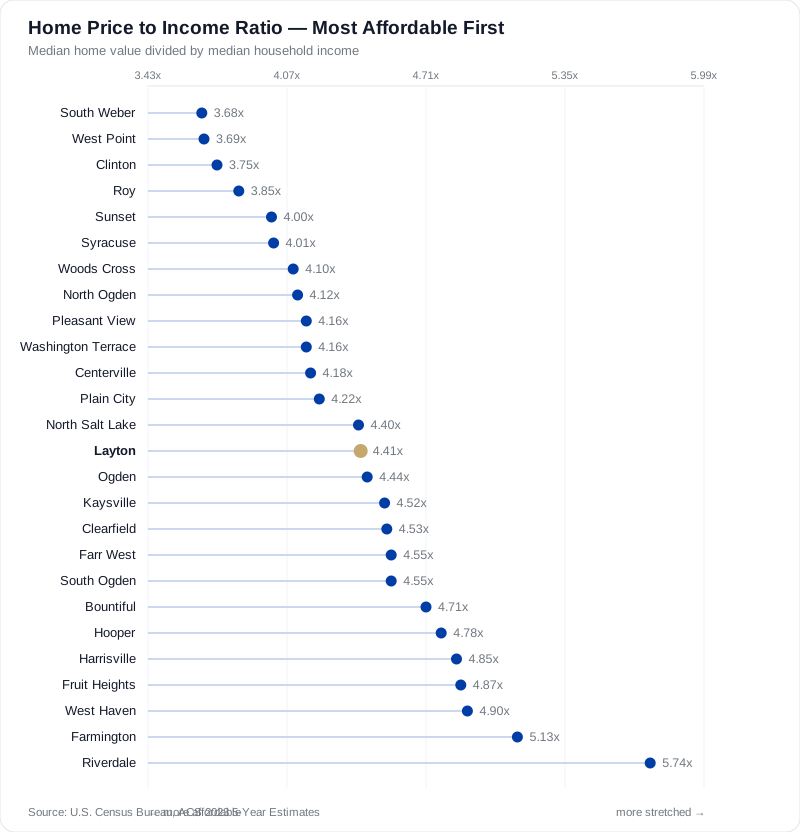
A higher ratio doesn't mean prices will fall. Farmington draws buyers from across the Wasatch Front, not just locals. But cities where values sit closer to local incomes, like Roy, have less of a gap to close if the market cools.
Utah First Time Home Buyer Interest Rates: Why Rate Beats Price
There's no single Utah first-time buyer rate. Your rate depends on your credit score, loan type, and lender. A change in rate often moves your monthly payment more than a small change in price does.
People search for Utah first time home buyer interest rates expecting one number. It doesn't exist. Rates change daily, and each lender prices them based on your credit, your down payment, and the loan program you choose.
Here's the part most "wait for prices to drop" advice misses. Your payment is driven by price and rate together. A modest price drop can be wiped out by a rate increase. On the flip side, a better rate can make a slightly higher price more affordable.
For first-time buyers, Utah Housing Corporation notes that credit scores above 620 are allowed on its loans, and that a higher credit score may qualify you for a lower monthly payment. Its down payment assistance is a second loan that only works alongside a Utah Housing first mortgage, through an approved participating lender. First-time buyer programs get their own full post; the point here is that improving your credit may do more for your payment than waiting on the market.
Free PCS to Utah Relocation Guide
Get my Hill AFB relocation packet — neighborhoods, VA loan tips, schools, and timelines — sent to your inbox.
Is It a Good Time to Buy a House in Utah? Who Should and Shouldn't
It's a good time to buy if you plan to stay at least several years, have stable income, and can afford the payment today.
The honest answer to "is it a good time to buy a house in Utah" depends on you, not the headlines.
Buying now likely makes sense if:
- You expect to stay put for several years, long enough to absorb the costs of buying and selling.
- Your job or military assignment is stable, and the monthly payment fits comfortably.
- You'll still have an emergency fund after closing.
- You found a home that fits your life, not just a spreadsheet.
Buying now is probably NOT right if:
- You might relocate within a year or two and don't want to be a landlord.
- The purchase would wipe out your savings, leaving nothing for a furnace or a roof leak.
- You're stretching to the top of your approval just to get into a certain city.
- You're buying mainly because you think prices will jump. That's a bet, not a plan.
If you land in the second group, renting another year is a smart choice, not a failure. I'd rather tell you that than sell you a house that stresses you out.
Waiting for a Price Dip: The Real Math
Waiting only pays off if prices fall by more than your extra rent and missed equity. At Ogden's 2024 median rent of $1,216, a year of renting costs about $14,600.
Let's run a simple illustration using Census ACS 2024 figures for Ogden. This isn't a forecast. It just shows how the tradeoff works.
Ogden's median gross rent was $1,216 a month. That's about $14,592 a year. Now say you wait a year and prices dip a hypothetical 3% on a home at Ogden's median value of $355,600. That saves you about $10,668 on the purchase price.
In that example, the dip doesn't fully cover a year of rent. To be fair, owning has costs too: interest, taxes, insurance, and upkeep. So rent isn't all "wasted" compared to owning. The real takeaway is that a small dip rarely makes waiting a clear win, and a rate increase during that year could cancel the savings entirely.
In higher-rent cities like Roy ($1,624) or Farmington ($1,769), the cost of waiting runs even higher.
How to Read the Northern Utah Market Yourself
Watch days on market, the share of listings with price cuts, seller-paid concessions, and inventory levels. When all four rise together, buyers gain leverage. That's a negotiating opportunity, not a crash.
You don't need a crystal ball. You need to know which signals matter.
- Days on market. Homes sitting longer means buyers have more room to negotiate.
- Price reductions. Lots of cuts on one street or in one price range shows exactly where sellers overreached.
- Concessions. Sellers paying closing costs or buying down a rate is a quiet form of price reduction.
- Inventory. More active listings means more choice and less competition.
These signals vary a lot by city and price point. A starter home in Ogden and a $700,000 home in Kaysville can behave like two totally different markets in the same month. I pull this data for specific neighborhoods when clients ask. You can also watch live listings and see how long homes you like stay on the market.
What This Means for Hill AFB and PCS Buyers
Military families rarely get to time the market, since orders set the calendar. Focus on a payment you can carry, and on whether the home would rent well if you PCS again.
If you're PCSing to Hill, your report date decides when you buy, not a market forecast. That's fine. The better question is "Will this home still work if I get orders in three years?"
Homes that rent easily near the base give you a real option if you have to leave. That usually means solid layouts, reasonable HOA rules, and locations with an easy drive to the gates. The VA home loan program is often the tool of choice here. VA loan details are covered in their own posts.
For the full picture on moving here, including base gates, neighborhoods, and timelines, read the PCS relocation guide for Hill AFB. You can also grab the free 208-page PCS and relocation guide.
The Bottom Line on the Ogden Utah Housing Market
Expect a steadier market, not a collapse. Ogden stays the most affordable entry point among the cities compared, and Davis County cities hold premium prices. Buy when it fits your life and payment.
The Ogden Utah housing market remains the most affordable of the eight cities covered here, based on 2024 Census data. Davis County cities like Kaysville and Farmington sit at the top. Layton, Roy, and Clearfield land in between.
Could prices soften? In some neighborhoods and price ranges, yes. Is a broad crash likely? The land limits, job base, and equity levels here all say no.
So stop trying to call the bottom. Figure out your payment, your timeline, and your must-haves. Then pick the neighborhood that fits. Start with the Weber County community guide if you're weighing Ogden and its neighbors.
Thinking About a Move? Let's Talk.
Call Donald I. Gomez for straight answers on Northern Utah real estate — no pressure, just local help.
Frequently Asked Questions
Will Utah housing prices go down in the next year?
What is the median home value in Ogden, Utah?
Is Layton more expensive than Ogden?
Should I wait for prices to drop before buying?
What interest rate can a first-time buyer get in Utah?
Which Northern Utah city has prices closest to local incomes?
How do I know if a specific Northern Utah neighborhood is cooling?
Does PCSing to Hill AFB change how I should think about market timing?

Donald I. Gomez
Donald helps buyers, sellers, and PCSing military families move across Northern Utah — from Ogden to the Wasatch. A longtime Hill AFB-area local, he tours new builds and resale homes every week on his YouTube channel.